On the slippery slope of losing, losing and losing again.
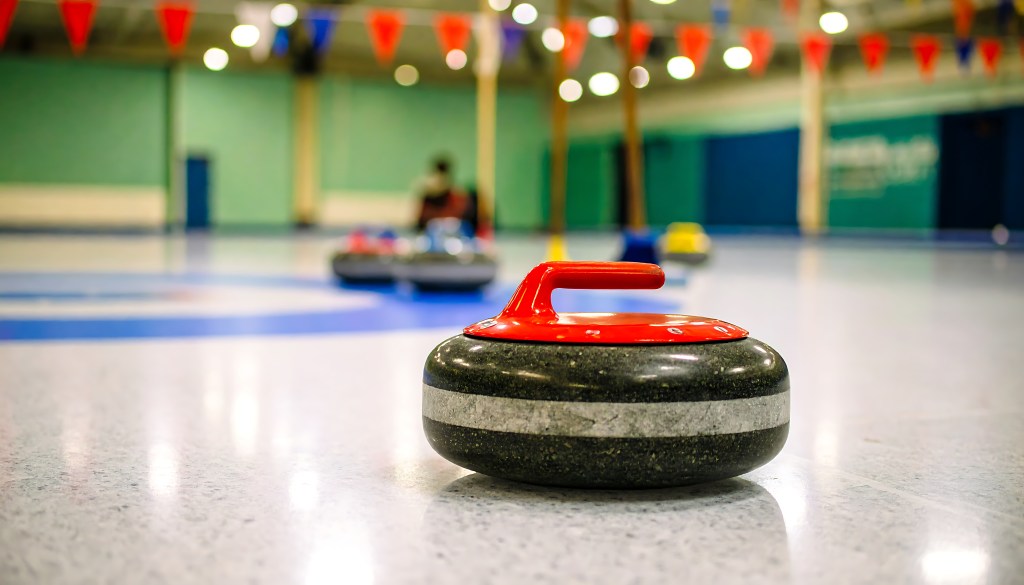
They say it’s a game of fine margins, a game where high-risk decisions can lead to high gains. It’s also called the roaring game. All I know is that it made me hate Bert McLelland.
I took up curling when I retired, some fifteen years after I was last on the ice playing hockey. In retrospect, it was a wise decision. Just ask my knees.
I have always loved the atmosphere of ice rinks. As a teenager in the 1970s, I’d go to Ayr Ice Rink all day and stay until the last bus home on a Saturday evening. It was thrilling to weave in and out of the skaters to the sound of “Jean Genie,” “Virginia Plain,” or “Maggie May” blasting — and I mean blasting — through the sound system. Showing off and icing fallen skaters were the highlights of any session. Of course, I would eventually overstretch, take a tumble, and make a fool of myself. Leaving the rink with my denims wet, my composure ruined, and my ego bruised was always a humbling experience for a young man.
In comparison, despite all the shouting, curling is a relatively tranquil pastime. It’s an established sport, popular with farmers, landowners, business owners, doctors, and academics. Those pesky hockey hooligans ruin the ice. Shouldn’t be allowed.
For the first time in my life, I took lessons. I had a lot to learn. There were the mechanics of sliding out and delivering the stone — it’s much harder than it looks. A good sense of balance and some bravery are required. Then there is sweeping the ice without knocking the stone or falling over, another tricky proposition. I had to get a handle on how to communicate through signals: front of house, on the button, hack weight, guard, barrier weight.
Most of all, I had to learn to shout with confidence. Everything happens so fast. It takes about twenty seconds for a medium-weighted stone to reach the target from the moment it’s released. In that period, you must give the team clear instructions. There is no time for debate — only time to act. If the skip says “sweep,” then you sweep. If the skip says “hurry,” you sweep faster. If the skip says “I’m a little donkey,” then he is either drunk or has completely lost his mind. It happens.
Skips need to do more than chuck the stone and get it closer to the button than the opposition’s. They choose the shots and guide the team just as they guide the stones. And they need to adhere to the rules. There is a lot to remember, including the unfathomable fifth-stone rule and a web of unspoken etiquette about who can do what, where you can stand, and under what circumstances a stone can be removed from the rink. It’s a game of fine margins where every decision counts.
In my third curling season, I was doing better than I anticipated. All my years developing muscle memory with a stick and a puck — learning to read the ice — were paying off. I was promoted through the positions, and that’s when all my trouble with Bert McLelland started.
Now that I was Skip, I thought it would be nice to win a few trophies. It was 2023, and my team was competing for first place in the club league.
Before proceeding, I need to explain something. There are four players in a curling team — the Lead, Second, Third, and Skip. The key to success is communication. By some bizarre set of events, all my teammates have similar-sounding names: Jack, Jack, and Jackie. Let me tell you, the game is hard enough, but when I’m shouting instructions and everyone answers to Jack, things become truly difficult. “Sweep, Jack. Not you — JACK.”
Back to the game. The score is 5–5, and we are in the last end. Jackie throws a beautifully drawn stone that narrowly curls past a guard and lands perfectly. I sense victory is ours when Bert McLelland says, “Your sweeper knocked the stone.”
I’m taken aback. All I can say is, “Did he?”
“Yes. I heard a click.”
“A click?”
“Yes, the stone was touched.”
I call Jack over. “Their skip says you knocked the stone.”
“No, not me. I never touched it.”
“He says he heard the brush hit the stone.”
This was the first time I had played against Bert McLelland. I didn’t know the guy. He seemed pleasant enough — knowledgeable, composed, and perfectly reasonable. All I knew was that he was a good player and one of the most experienced in the club. I wanted to challenge him, but there was no referee to adjudicate. If he said there was a knock, then there was a knock. So I agreed to kill the stone. Four throws later, we had lost 7–5, and my first chance at a trophy was gone. Something didn’t feel right.
It’s 2024, the end of winter, and we are in the cup final. We are underdogs facing Skip McLelland in a rematch, but I feel confident. Our curling was good at the start of the season, and it had only improved. We were in with a real chance.
It’s a bad start: 3–0 down in the first end, 6–0 down by the end of the fourth. We claw back two in the fifth end and then a fantastic three in the sixth. Six–five to Bert, with one end to go.
I blame myself for what happened next. I failed to keep my cool. I forgot that I was curling and not playing hockey. Bert had the last stone. We had a stone in the four-foot ring. A draw into the pin would win it.
I could tell when he released it that it looked good — maybe a little heavy. His sweepers were unsure, talking and checking with each other. “It’s good, it’s good.” I wasn’t so sure. I got ready to sweep it past our winning stone. I can’t explain why, but in my eagerness, I forgot that I could only sweep the opposition stone after it had crossed the T-line. I pushed Bert aside, jumped in, and swept like a madman.
His stone slowed down. I could hear my team shouting, “Sweep, sweep.” Miraculously, it kept going — over the center button — and came to a halt inches past the front edge of our stone. We’d won the end. The score was 6–6, and we were going into an extra, game-deciding end.
“Foul sweep,” says Bert.
Immediately, I knew he was right. I had jumped in before his stone crossed the T-line. I apologized. Jackie told me that it was up to Skip McLelland to place the stone where it would have stopped if I hadn’t intervened.
He nudged his stone close to the button. I lost my cool. I knew I was wrong, but I was angry.
“You can’t put it in a winning position,” I said.
“I have to put it where it would have stopped,” he said — calm, measured, his eyes never leaving mine.
“It would have gone through.”
“No, it was sitting down perfectly. A winning shot.”
It was his thirty years of curling experience and status against my three years of pretending I knew what I was doing. I knew immediately that I couldn’t win. Defeat descended over me — flush-faced, my spirit extinguished. I shouldn’t have thrown my brush down on the ice, and I definitely shouldn’t have kicked his stone. Luckily, I stopped myself before things got ugly. We agreed, shook hands, and met up in the bar.
I apologized for my behavior. Bert explained the rules to me. He was right, of course. He had no choice but to place the stone where he thought it would have landed without my intervention. For thirty years, he had been watching how curling stones behave on ice. I bought him a whisky, drove home, and couldn’t sleep. I was sure I’d been duped. Maybe I’m a bad loser. Over and over, I replayed the final motion of Bert’s stone, and each time, in my mind, it kept running past the four-foot ring.
I was determined that 2025 was going to be different. We were in the cup final for the second year running and, again, playing against Skip McLelland. I was older, wiser, and more assured in my game craft.
We were in the sixth end, tied at 4–4. Bert’s last stone was closest to the button. I just needed to draw in closer to go 5–4 up going into the last end. I stood at the hack, doing everything in my power to remain calm and focused. My sweepers were in position. I softly gripped the handle, pulled the stone back, pushed, slid, and released.
I could tell immediately it was well weighted. The line was good. Jack and Jack kept a close eye on it but didn’t sweep. I could tell they felt good about it too. I gave a restrained command — “Never, never” — making sure they weren’t tempted.
My stone sat opposite Bert’s, just off the button. It was too close to call. We all studied the distances from the centre mark. Jack said, “We need a measure.” I agreed — it was impossible to tell. Then I saw Bert whispering to his Third.
There is an important rule in curling: it is the Thirds — not the Skips — who decide and agree on the score at the conclusion of an end. If it’s close or they can’t agree, then a measure is taken. To my surprise, Bert’s Third said, “One for red,” and moved his blue stone aside, removing the chance to measure.
Something didn’t smell right. I felt we had been played, but I didn’t yet know how. They had given us the benefit of the doubt and conceded the end. We were now leading 5–4 going into the last end. Then it struck me. Bert wanted the last-stone advantage — the hammer — in the final end.
I’m at home. My wife asks me how we did. I tell her I hate Bert McLelland — but that I’m going to beat him next year.
“How?” she asks.
“By becoming a better version of Bert McLelland than Bert McLelland can ever be,” I reply.
© Steve Gillies 2026. All rights reserved.
 Steve Gillies
Leave a comment