What is woven cannot be unwoven
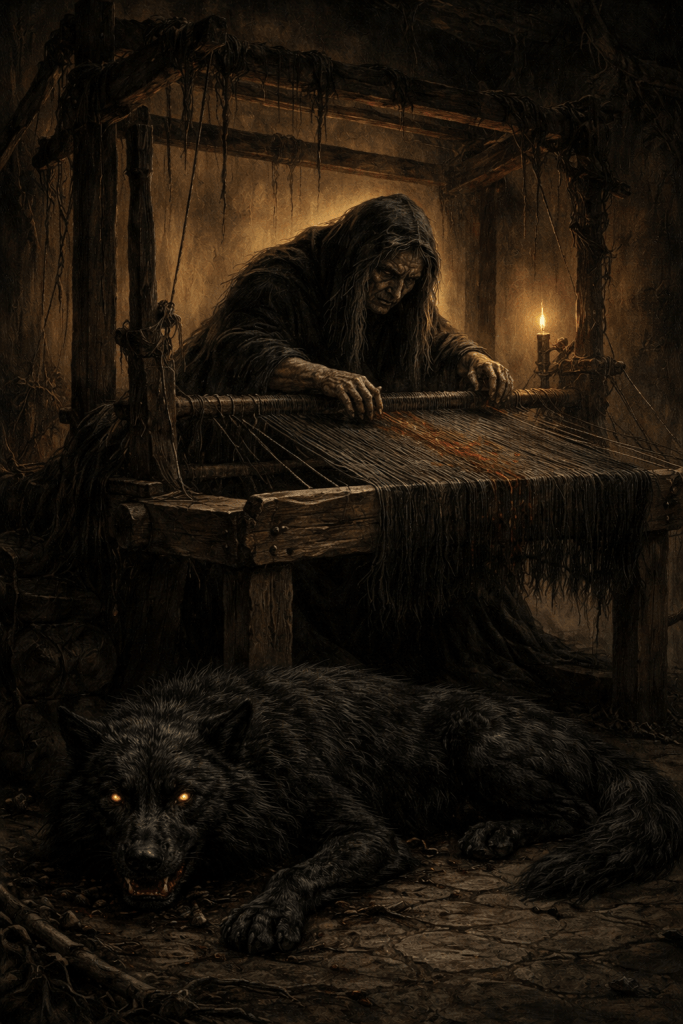
Jane couldn’t sleep. Nothing unusual about that, she thought – but tonight, her mind was more restless than ever. Little did she know that a few hours lost sleep was going to be the least of her troubles before dawn.
Outside, a late October chill crept over the Vale, urging the good folk of the town indoors to seek warmth and companionship against the first bite of winter darkness.
Jane had only recently moved into Briar Cottage – a two-loom weaver’s house on Ranoldcoup Road. Built in the early 1800s, she adored its past and echoes of lives lived under the thatched roof; that was what had drawn her to it in the first place. After the sudden death of her husband, it was the first home she had bought on her own. Her last home, she’d called it fondly. The one she would leave in a box.
Often, she’d sit by the fireplace and let her mind wander through the stories that lingered in its walls and mingled with the shadows of the fireglow – the laughter of celebration, the cry of a newborn, the hush of a final breath. Everyday human emotions, all woven, like fine lace, into the fabric of Briar Cottage itself.
This had once been a place where families go hand weavers lived and worked side by side.
Throughout the nineteenth century, the Vale was renowned for its fine flax and cotton weaving – the damp climate keeping the threads supple and strong. The arrival of the power loom brought change and cheaper materials – yet the family who lived in Briar Cottage had stubbornly held on to their craft and to the wool produced for the black faced sheep of these hills and glens. Briar Cottage and the families that chose to live there had always seemed a bit different.
Soon after moving in, Jane discovered that the cottage’s original handloom had survived the decades. Someone had it lovingly restored and moved to the small stone outhouse at the back of the garden – the same space where a dairy beast would have been kept and protected, its milk augmenting a diet of garden produce. Her favorite detail was the sight of tiny, age-old fragments of wool still caught in the loom’s worn timber.
Jane turned onto her side and tucked the duvet tightly around her. There was a position, she knew from many restless nights, where sleep would find her. When she did fall asleep it was too deep for dreams to surface to her consciousness. Her mind was as dead as her her body was still, her body still.
Then it began: a distant but persistent sound, faint yet distinct.
Click … clack.
Click … clack.
Jane’s eyes opened wide. Immediately awake and alert, her heart thudded, sugar levels spiked with the rush of adrenaline. Some old, instinctive part of her warned: don’t move, don’t breathe, lie still.
There it was again – click, clack, click, clack – a procession as steady as a strong heart beat, the rhythm perfectly even, the tone unchanging.
She lay frozen, every nerve alert, listening, measuring the silence between each sound, trying to work out what it was … and where it was coming from. Was it getting louder, or, heaven forbid, was it coming closer?
A few minutes passed. Enough for her fear to retreat and for reason to return.
It can’t be the house settling, she told herself. It’s far too regular – too deliberate – for anything natural. The house is old, prone to creaks, sighs, and moans when the night turns cold but this was different. This had a creator.
Perhaps, she thought, it is a branch outside, brushing and tapping against the window? But there is no wind.
Too weary to investigate the source of the sound, Jane turned onto her side, exhaled softly, and tried to quiet her mind.
When the singing started, all hope of sleep was lost. Someone or something wasn’t going to let her rest.
A low, mournful melody drifted through the stillness – no words at first, just a gentle humming, the tender rise and fall of a woman’s voice keeping time with that same, steady beat. It was hauntingly beautiful, the kind of tune one might hum for comfort or remembrance, and it stirred something deep and sad within the soul.
Now and then, she thought she could catch a word or two, but they dissolved before meaning could form. Half awake, half dreaming, Jane told herself it was nothing more than her overtired imagination – the tricks of a restless mind in an old house full of echoes. Whoever – or whatever – was disturbing the night’s peace had no intention of letting Jane drift back into sleep.
The singing shifted suddenly into soft sobbing, then a desperate cry.
“Help me … help me … come, Jane.”
Jane sat bolt upright.
What the…?
Her heart hammered in her chest. Am I imagining this?
She swung her legs over the side of the bed and listened.
The voice came again – “Help me … help me …” – weaker now, fading into the night, yet still carrying an eerie insistence that made the hairs on her neck rise.
A chilling realisation struck her like a bolt of ice.
This isn’t something I can ignore. Hiding under the duvet isn’t an option.
She pulled on her dressing gown, slipped her feet into slippers, and with a reluctant shiver of resolve added a scarf and woolly hat. She knew the outhouse would be dark, so she reached for a torch, its cold metal casing grounding her trembling hands as she prepared to step into the night.
Through the small-paned, frosted window, Jane saw the faint flicker of candlelight. The singing had stopped, yet the steady click-clack of the loom carried on, measured, insistent, and relentless.
She paused at the doorway, her breath clouding in the chill air. A tremor ran through her body, part cold, part fear. Her hand hovered near the latch.
“Come in … don’t be afraid,” announced a soft voice from within.
Jane froze.
The night seemed to hold its breath – and then, from somewhere deep in Lanfine Woods, an owl hooted, its hollow call echoing like a quiet mockery of courage.
What she saw would have felled a weaker soul.
But Jane was strong-willed.
She stepped into the stone outhouse.
Despite the stillness of the night, the heavy door slammed shut behind her.
Sitting at the handloom was an old hag.
Both hands gripped the baton, driving it forward and back with a slow, relentless rhythm. Her skin was a mottled olive green, knotted with warts and calluses. Her nails were long, black, and thick with earthy grime. Two plain gold bands circled her wedding finger, and on her right hand gleamed a jet stone, black enough to swallow the sunlight.
Black-toed, bare feet, the same green hue as her hands, pressed the treadles in time with the loom’s whispering pulse. Each thud of the loom echoed like a heartbeat in the small stone room.
Her clothes were simple – a white silk blouse beneath an ankle-length woollen dress, edged with delicate lace trimmings. Black, of course.
Long gray hair, dry and unbrushed, hid half of her face.
In a deliberate act of revelation, the hag brushed her hair aside. Jane – normally never lost for words – was struck dumb. It wasn’t the hag’s clothes or her green, warted skin that froze her tongue, but the terrible fact that the old woman had only half a face. The other half was nothing but scarred darkness, as if something had burned or bitten it away. A precise boundary ran vertically down the middle. Half hag, half nothingness.
A low growl emerged from the shadows. Jane gasped when two wolves padded out from a dark recess and lay on either side of the loom, their eyes glinting in the flicker of candlelight.
“Don’t worry,” said the hag, her voice rasping like cloth through a reed. “The dark one is Morcair. She will only be dangerous if I ask her to be. Fàelan is her son. He is still learning, but he’ll do what he’s told.”
Recovering her composure, Jane asked, “Are they … wolves?”
The hag’s half mouth twisted into something almost like a smile. “They are Beowolfs – direct descendants of Fenra, the first wolf born of shadow and moonlight. They live between the spectral and the natural worlds.”
Jane, now feeling curious and a little braver, took a step closer. “What’s the matter with your face?” she asked quietly.
Fàelan rose to his feet, a low growl rumbling in his throat.
“Stad, Fàelan,” said the hag. “Laigh sìos!”
The creature obeyed, though his yellow eyes never left Jane.
“I’m in the time of transition,” said the hag. “When what has been is never more, and what will be knocks at the door. It is why I summoned you.”
“Summoned me?” asked Jane.
“Sit where the shuttle boy sat,” said the hag, pointing to a chair opposite her. “This is where and when your future is decided. You have been chosen, and the weaver’s test must be complete before sunrise. You must pass the shuttle to and fro between the threads one thousand times while I work the warp and the weft. The colours that emerge will tell of your past and set your fate.”
Jane didn’t believe in sorcery or magic, but with the door locked, the hag’s insistence, and the threat of Morcair and Fàelan on high alert, she didn’t feel she had much choice.
“OK,” she said. “How does this work?”
The hag started slowly, allowing Jane to get into the rhythm. At first, the woven blanket was colourless, representing a new beginning. The first passes of the shuttle were soft, hesitant – click, clack, click-clack – until the rhythm steadied into something ancient and hypnotic. Jane’s movements matched the beat, her body obeying the loom’s strange command. Soon, the hag’s hands moved with impossible speed, her fingers darting between threads as the loom galloped with all the speed of the wildest beasts.
Before her eyes, the threads began to shimmer and shift in color. The first hue to bloom was a pale dawn pink, delicate as breath – her birth, the beginning of all things. The colour pulsed faintly, alive with promise.
Next came butter yellow and meadow green, threads of childhood, bright and quick as laughter, the tones dancing and tangling together, wild and unplanned.
The shuttle slid again, and deeper tones appeared – violet and restless indigo, the storm of adolescence, streaked with silver like rain against glass. Jane felt her pulse quicken as the rhythm changed, faster, more demanding.
Then came womanhood: deep crimson and gold, colors that burned and shimmered, full of passion, courage, and mistakes made honestly. The loom hummed with its own heat.
The pattern shifted once more, softening into ivory, navy, and ash gray – her married years, intertwined strands binding strong but worn thin at the edges, love and duty holding their pattern through time’s pull.
Then followed the tones of maturity – earth browns and russet leaves, autumnal and wise, the weave tighter now, more deliberate, its beauty found in quiet symmetry.
And finally, the colours dulled to pearl, dusk blue, and fading silver – now, the present moment – calm, reflective, threaded through with glints of all that had come before.
Jane’s arms ached; her breath came shallow. Yet she couldn’t stop. The loom itself seemed to breathe with her, each strike of the shuttle drawing her deeper into its spell.
When the hag finally raised her hand, the threads stilled.
A single tear rolled down Jane’s cheek as she looked upon the finished cloth – her life, her memories, her loves and losses, woven into one living blanket that shimmered in the candlelight.
The hag stopped. She seemed to hesitate, for the first time unsure of herself.
Morcair whimpered.
Jane stared at the woven blanket, mesmerised by its shifting hues – until the hag started again, the final part, the prophesying part, of the hand weaver’s tale.
The transformation was slow, deliberate, as though the loom itself mourned the loss of colour. The greys deepened – stone, slate, charcoal – spreading like gathering storm clouds. The once-luminous threads dulled under a creeping shadow.
Jane’s hands faltered, but the hag motioned for her to continue.
“Do not stop,” she whispered. “All stories must find their end.”
The black came next. Not a single black, but layers upon layers – a darkness that absorbed light, swallowing every glimmer of what had been. It was heavy, endless, suffocating.
Jane felt her chest tighten with it.
Then, just as she thought the cloth could darken no more, a single thread of gold began to emerge – faint at first, then clearer, brighter – running through the centre like a pulse of life. It glowed against the void, trembling with fragile hope.
But as swiftly as it appeared, the gold thinned and was followed by endless black.
The final weft passed through with a hollow click.
The loom fell silent.
The hag exhaled – a long, weary sigh.
“There,” she murmured. “The last line has been drawn.”
Jane looked down. The blanket was beautiful and terrible all at once – an ending wrapped around a secret promise, a single heartbeat of light in the dark.
“You are free to go now,” said the hag, her voice softer than before, as if the weaving had drained what remained of her strength.
“Go?” Jane’s words trembled. “But what does it mean? What is it trying to tell me?”
The hag’s eyes glimmered like candlelight on water.
“The loom has spoken,” she said. “My work here is done. The thread I began in this realm will soon be woven into the tapestry of the next.”
Jane hesitated, her voice barely a whisper. “And what of me?”
The hag smiled – a faint, knowing smile that seemed both kind and sorrowful.
“Your time will come soon enough,” she murmured. “But first, you must see that the final chapter in the tapestry of your own life is made ready – that it can be passed on when the shuttle falls still. Once done, your place is here with Morcair and Fàelan.”
Jane stretched and opened her eyes. Pale October sunlight filtered through the thin curtains, washing the room in a cool, watery glow.
What a dream … what a night, she thought, still heavy with sleep. I feel half-alive. Half dead.
She sat up slowly, the details of the night already beginning to blur like mist. It was going to be one of those hazy, half-waking days when nothing quite feels real. When indecision and self-doubt plagues your very soul.
Yawning, she shuffled to the bathroom. The air was cold against her skin as she filled the basin with steaming water. She cupped her hands, splashed her face, and blinked hard.
When she lowered her hands and looked into the mirror, her breath caught in her throat.
The reflection stared back – familiar yet impossibly changed.
The backs of her hands had turned a deep, mottled olive green, the colour of aged moss or ancient cloth. And there, upon her cheek, a small section of her face was simply gone – as though time, or the loom, had started to unravel.
@Copyright 2026 Steve Gillies. All rights reserved.
 Steve Gillies
Leave a comment