This first part opens where many good stories do: in the pub, after a bad result, with a dram and a blether. As memories and gossip surface, the talk turns to Alexander Fleming, the war, and a discovery that might have come too early—or not at all.
It’s a Wednesday evening; I’m in the Sheep’s Heid, it’s football night and the bar is jumping. Fans are out in force, half in blue, half sporting green. The referee blows the final whistle. Five nil. Five bloody nil.
The cheering and taunting kick off. Thankfully it stays good natured. I drink the last of my beer. Five nil. It’s true what they say. It’s not the losing that kills you, it’s the eternal hope.
Frank McClelland shuffled up beside me with the offer of whisky in his hand. “Here Calum”, he said “This will help soothe the pain.”
I nodded.
“It’s also a wee thank you for helping Caroline get her car out of the ditch last week”. Frank is a retired GP and just about everyone in town has been treated by him. He’s got a good old fashioned bedside manner and has the knack of distracting you with a story while stabbing you with a syringe.
“I was just happy to help.” I said, “The snow was heavy and she did manage to get herself stuck well and good. You should dig into those deep pockets of yours and buy your wee girl a four-wheel drive you auld miser”.
Frank laughed. “Aye, that’ll be right. Who do you think I am, Carnegie? Anyway, where did she get stuck—up by the entrance to the old school place?”
“Aye. Just where the road dips and turns right. She tried rocking it free, but only made it worse. I pulled her out with the tractor.”
“I’m glad you could help. I don’t like the thought of her stuck up there on her own. It can be dangerous in the winter.”
I nodded. We all knew what had happened in the winter of 1997.
Frank went on. “Do you see much of Jim nowadays? He’s been a bit of a hermit since Chrissie left him. I suppose he’s busy with his Fleming research.”
“No, come to think of it, I’ve not seen him this winter. But I can see he’s been working on his barn. I should maybe visit, see if he’s alright.”
“Good idea. Just don’t get him started on Fleming and penicillin. You’ll be there all day.”
“The man’s obsessed,” I said.
“That’s for sure,” Frank chuckled. “You should’ve heard the tale he told us the last time he was in here.”
I hesitated. Frank likes to take the scenic route. It’d been a long day—my team got gubbed, and I was tired.
“Go on,” I said.
Frank did as I requested.
“It was last winter. Just over a year ago now I think about it. Aye, near Burn’s Night, because I remember asking him if he was delivering an address at the supper. He does a great Tam o’ Shanter, you know—but I prefer his Address to a Haggis.
“Have you heard him? Knows every word. Never makes a mistake. Given how much he likes to show off, I was surprised when he said no. Said he was too busy.
“We were all sat round that table over there. Boaby was there. Hugh. Alfie. Joyce—you’ll remember Joyce from school. Married Bert McGhee fae Gawston, but they divorced after he took to the drink. Last time I saw him he was being thrown oot the Black Bull.
“Alfie was in great form that night. That man can tell a story or two. D’you remember him climbing the big oak in Lanfine and getting stuck? Fire brigade had to come. Drink may have been involved. That wisnae yesterday. He’s some man.
“Boaby was fine then. Picture of health. I still canny believe he’s gone. Just goes to show—you never know what’s roon the corner. Must’ve been devastating for Jessie.”
“Frank,” I said. “You were saying Jim told you a story.”
My patience was already frazzled.
“Ah, aye. I do blether on when I get the chance. To cut a long story short—Jim found an old diary. By Fleming. From 1923.”
“We’ve got lots of Fleming records.”
Frank rubbed his brow. “Not like this. It shows he could have made the discovery five years earlier—here in the Vale.”
“Really?”
Five years. I let that sit. Five years would have changed everything. Penicillin rushed into production, fast-tracked by governments and pharmaceutical companies, saving soldiers’ lives, then millions more. A quiet accident turned into one of the century’s great pivots.
“Why was Fleming in the Vale in 1923?”
“We don’t know. My guess? He needed time to recover from the war.”
“Was he on the front line?”
“No. But close enough to see things he’d rather not have seen. That kind of exposure leaves a mark.”
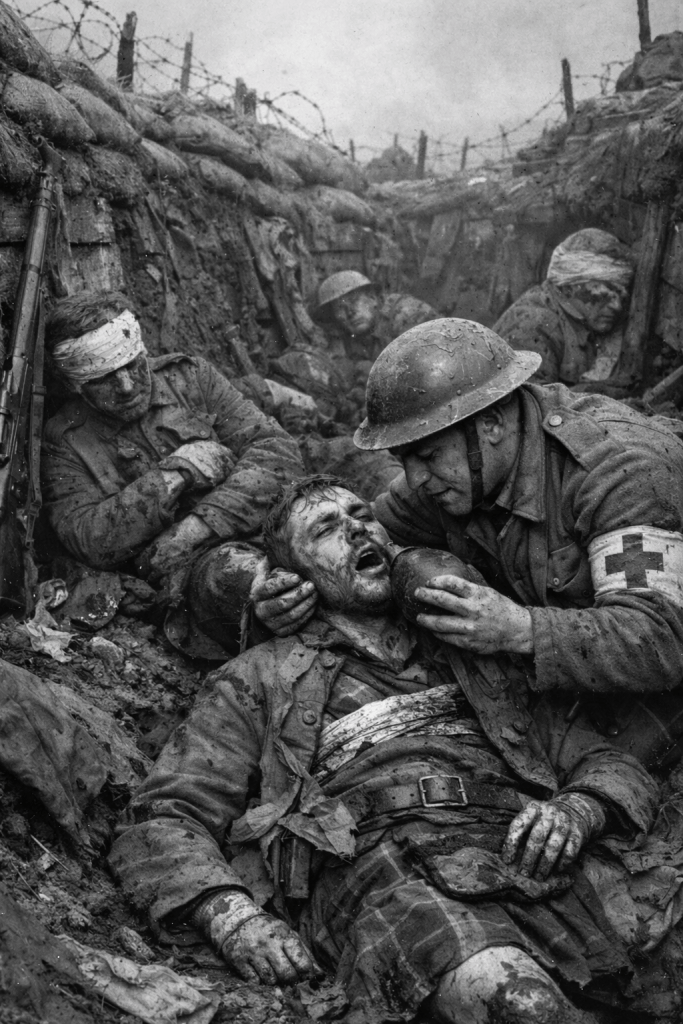
“God,” I said. “It must have been devastating. I visited the Somme last year. You can still feel it—the danger, the hopelessness. Day after day of dead and broken men.”
“Especially as a medic,” Frank added. “He’d have seen unspeakable injuries. Burns, wounds, amputations, infection. A never-ending nightmare.”
“Maybe that was it,” I said. “He wanted some peace. Somewhere familiar. Somewhere he’d been happy as a boy.”
Frank shook his head. “Aye—but more than that, he wanted to work. The war left a mark on him. A frustration he couldn’t let go of.”
“What do you mean?”
“He had so few tools. Most of the time all you could do was cut away dead or infected tissue and hope for the best. He would have used carbolic acid, iodine—strong stuff. Half the time it burned the patient as much as it helped.”
I interrupted. “I saw a surgeon’s field kit in the Flanders Museum once. It didn’t look like much—forceps, tourniquets, mallets, a bone saw. It doesn’t bear thinking about. He must’ve learned a lot about wounds. About infection.”
Frank nodded. “Aye. Later on, he wrote about what he’d seen. Bayonet wounds are long and narrow—nearly impossible to clean properly. Deep punctures turn into breeding grounds for abscesses and blood infection. Shells and grenades drive shrapnel, dirt, even fragments of uniform deep into the body.”
He went on. “Shattered bones. Gangrene. Everyday things. Then trench foot, dysentery, tetanus, chemical burns—not to mention the damage mustard gas did to the lungs. It’s a wonder he, or anyone, survived.”
“He did,” I said.
“Aye. And I think when he came to the Vale it was to put some distance between himself and all that—and to focus, properly, on finding something better.”
Frank reached into his bag and took out a bundle of papers. He handed them to me.
“Read this,” he said. “It’s a copy of Fleming’s journal. The one Jim found.”
Coming soon. In Part 2 we are introduced to Fleming’s journal entry on a remarkable day.
@ Copyright 2026 Steve Gillies. All rights reserved.
 Steve Gillies
Leave a comment