Fleming has lunch in The Sheep’s Heid, heads back to Lochfield and meets Kinny Donal. Part 4 can be found here.
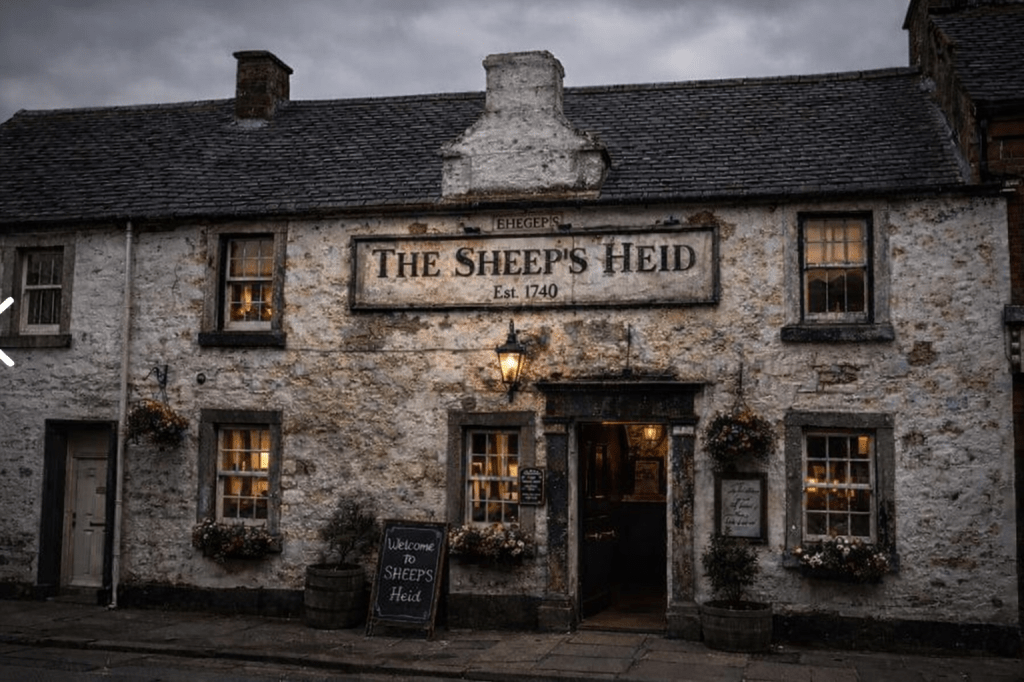
The Sheep’s Heid is a fine establishment—cosy, inviting, and steeped in the comforting hum of familiarity. The landlord – despite gossip – is a genial host, quick with a tale, often punctuated by a knowing wink and a hearty laugh. Stories—mostly tall ones—and laughter flow as freely as the ale.
On Friday nights the place truly comes alive, the whole town seemingly squeezed into its walls, voices rising in good-natured banter, shared recollections, and the occasional burst of song. It is more than a pub.
Being Saturday lunchtime, it is already lively.
At a window table, four men hunch over a fiercely contested game of dominoes, their concentration broken by triumphant shouts, frustrated knocks, and affectionate ribbing. Along the bar, clusters of patrons—many draped in blue football scarves—raise their voices in animated discussion.
“C’mon the Vale!” rings out above the din as speculation mounts over how many goals Jock McEwan will put past Auchinleck Talbot in the cup that afternoon.
I ordered a half-pint of McEwan’s—a crisp, refreshing beer, just right for the middle of the day—and settled in with a steaming mug of boiled peas and tender ham hock, drenched generously in sharp vinegar that bite pleasingly at the senses. It may be summer, but warm peas, smoked ham, and vinegar, washed down with a malty beer, make an irresistible combination.
The rich, peaty aroma of whisky drifts from the bar, testing my resolve, but I resist. I needed a clear head for the work awaiting me this afternoon.
If my initial observations are borne out, the coming weeks will prove critical—and the labour unrelenting. The judgement of one’s peers is exacting and essential, permitting neither carelessness nor omission.
My first priority must be to document the work with precision: the nature of the bacteria, the composition and preparation of each test substance, the conditions under which they were examined, and every conceivable source of contamination. Each observation, however slight, would need to be recorded alongside the most plausible explanations available.
Such scrutiny will be required for every combination of culture and compound. The task promises to be exhausting, yet there can be no alternative if the results are to possess any integrity. Rigour, after all, is the foundation upon which discovery rests. The fact that I had relied upon my own preparations will only add to the complexity.
I found that I wished to continue the work at Lochfield. To do so, however, will require assistance, improved apparatus, and a thorough reorganisation of the laboratory. A typewriter will be indispensable; the sheer volume of notes and records will soon exceed the limits of longhand.
The scale of the undertaking is daunting. Yet the exhilaration of inquiry outweighs any unease. I felt again a familiar stirring—a spark long dormant. I was determined and committed to return to the bench, to immerse myself in the work, and to see where careful investigation might lead.
I was eager to return to Lochfield.
Turning east along the long, straight stretch of Main Street, I passed the site of the old toll gates.
Near Priestland I turned left, beginning the steep climb past the cemetery. The road rose sharply, the ache in my legs a reminder that time had altered me more than it had the land.
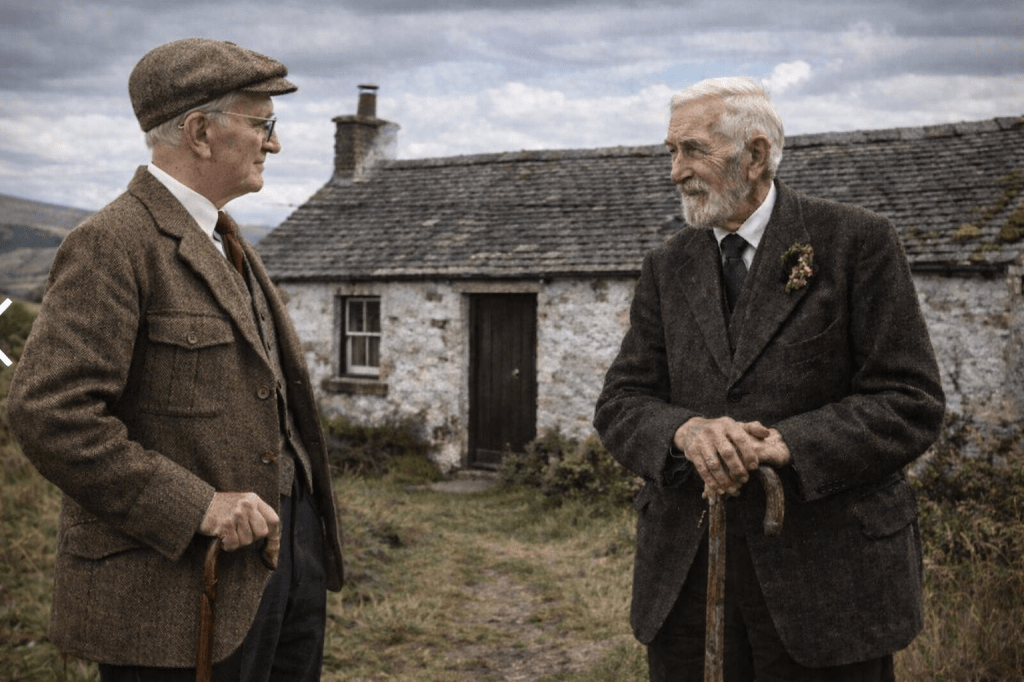
As I passed Leloan Cottage, a voice called out, “Dr Fleming, is that you?”
I looked across to see Cunningham McDonald—Kinny Donal to everyone—waving with unabashed enthusiasm. A familiar figure from my youth, Kinny had long earned his living as a cadger, peddling and delivering goods from farm to farm. With seventeen children from two marriages, it was little wonder he was forever alert to the next chance to earn a few shillings.
“Hello, Kinny,” I called back, suppressing a flicker of irritation at the interruption.
“Out for a walk? It’s a bonnie day.”
“Aye,” I said, pausing despite myself. “Heading back to Lochfield. Not quite as easy as it was when I was a lad.”
Kinny laughed. “Aye, if only all the hills ran downhill. How’s your brother Hugh? I’ve not seen him since the bonspiel last winter. Ach, that was a guid caul day—plenty of whisky to keep us warm. The stones were fair flyin’!”
“He’s well,” I replied. “I’m here for the summer, though I’m no use on the farm.”
“Aye, I heard you’re doing some kind of research—and looking for old beef. I can help you there, if you like,” he added with a knowing grin.
“That may well be useful,” I said. “In fact, I’ve had something of a breakthrough and will be needing more in the coming weeks.” I hesitated, then added, “But just now I must be on my way—Sarah will be expecting me.”
Kinny smiled. “Aye, away with ye then. Better to be with your fine wife than an auld rogue like me.”
I laughed. “I’ll be in touch, Kinny.”
Just as I thought myself clear, Kinny’s voice called out behind me.
“Do you need any milk? I’ve a cool churn full—I could bring it up this afternoon if you like.”
I paused. It was a generous offer, but I knew the risk.
In recent years, tuberculosis had become increasingly common, and I was keenly aware of the dangers. Mycobacterium bovis could be present in milk from infected cattle, even in animals showing no outward sign of illness. Although pasteurisation was beginning to be adopted in parts of Britain, it had yet to reach Ayrshire, despite the county’s reputation for its dairy herds.
I had already spoken to my brother Hugh about the matter, and he was careful to arrange our milk from trusted sources. I had no reason to believe Kinny’s lone cow was diseased—but caution seemed the wiser course.
“Thanks, Kinny, but we’re well enough supplied this week,” I called back. “Perhaps another time.”
He nodded and waved, and I continued on my path—relieved to have avoided another long exchange, yet troubled by the thought of how easily unseen dangers slip into the ordinary patterns of daily life.
I remembered the diseases of my childhood. Cholera, diphtheria, tuberculosis. I remembered Nell McDonald.
@ Copyright 2026 Steve Gillies. All rights reserved.
Part 6 can be found here.
 Steve Gillies
Leave a comment