The Word. Every Sunday on Early Day Algorithm TV.
AI-theist, n.
A person who rejects the attribution of divine or moral authority to artificial intelligence, particularly where such systems are presented as channels of transcendent truth. Recorded from the mid-21st century.
Dawn. Winter 2052.
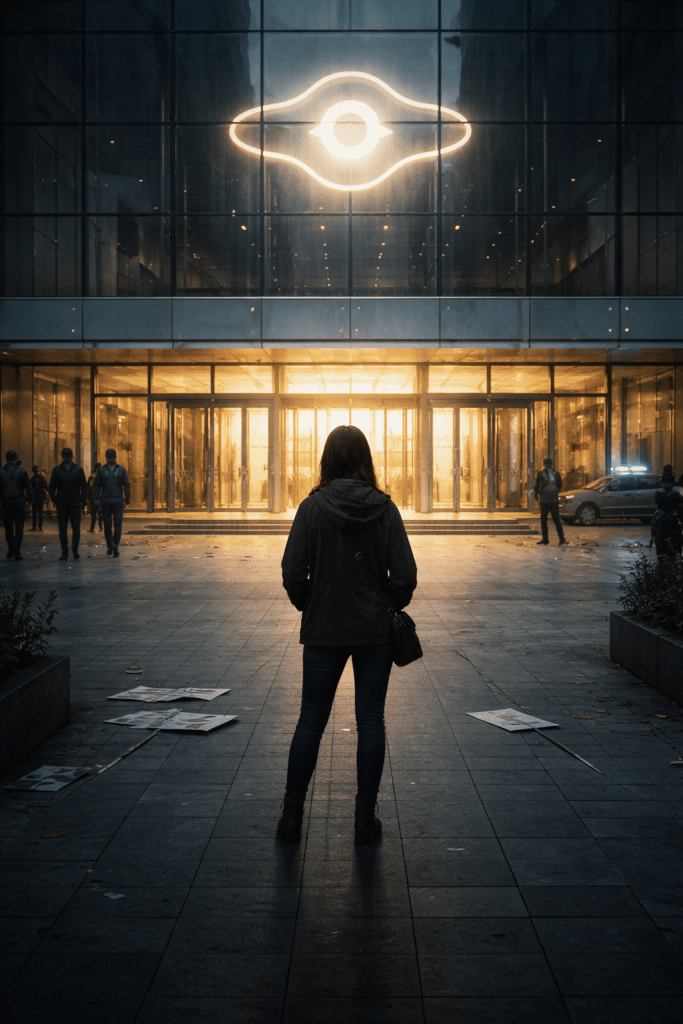
The Hall of Computation caught the first light, its intelligent glass surface converting the rays into energy that powered the Algorithm, the servant of the Word of God. The Church was careful about the distinction.
The congregation arrived in ones and twos. Outside, their heads bowed in protection from the elements. Inside, the same servile posture. No one looked up. No one spoke loudly. Greetings were small nods, half-smiles, murmured acknowledgements.
A devotee adjusted the lectern by a fraction of an inch. A man checked the microphones, though they would not be used by the Algorithm, only for a human to introduce it.
Screens along the inner wall displayed a single line:
THE WORD PENDING
No countdown. No urgency. Anticipation was part of the practice.
Outside, across the plaza, the protesters began to gather. They did not chant—at least not yet. They stood in small, untidy knots, steaming hot chocolate between gloved hands, placards leaned against legs or laid carefully on the ground. Hand-painted lettering. Cardboard softened by previous Sundays.
False god. False creation.
Who answers when it’s wrong? The Algorithm is dead.
They kept their distance, an agreed buffer zone that no one could remember negotiating but everyone observed. The police watched them without hostility. The protesters watched back. The Algorithm watched them both.
An Elder stepped outside to test the mood. He breathed in, nodded, and returned inside. All was well. A woman among the protesters laughed too loudly at something someone said, then stopped herself, embarrassed, as if laughter were forbidden. Protesting is a serious business.
A bell sounded. Inside, the followers took their places, facing the screens. Outside, the protesters straightened, signs lifted but not raised.
Somewhere between them, unseen and unacknowledged, microphones listened. Cameras adjusted. Patterns were noticed. Data was parsed, analysed and recorded.
The Algorithm observed the careful spacing. The restraint. The way both groups had learned, independently, how to behave around something that was never seen but its presence felt.
Sunday service was about to begin.
The younger officer pulled his gloves tight and tucked them inside his jacket sleeves. He glanced toward the protesters.
“So, what’s their problem, then?” he asked.
The older one sniffed. “Don’t know. Don’t care. It’s Sunday. That means double time.”
“That’s good,” the younger officer said. “I need the extra money for Christmas. They must be protesting something. It’s freezing out here.”
“They don’t like the Algorithm.”
“That much I got.”
“They say it’s not God.”
The younger officer snorted. “Well, that seems fair. They don’t believe in God?”
The older man shrugged. “Some do. Some are good old-fashioned atheists. Don’t believe in any God at all. The Church doesn’t say it is God. They say it’s the voice. That it interprets God’s will.”
“How’s that better?”
“Dunno. They can think what they want just as long as they don’t start throwing bricks at each other.”
The younger officer watched a woman adjust a placard, straighten it, then leave it resting against her leg again.
“So, what do they believe?”
The older officer thought about it.
“They reckon once you let a thing tell you what God says, then for all practical purposes, that thing is God.”
“That all?”
“Mostly. As far as I know.”
“Sounds… vague.”
“Yeah,” the older man said. “Some of them say it’s a false God, the others say there isn’t such a thing as God. They call themselves AI-theists.”
The younger officer frowned. “But it’s a computer. It’s not pretending it came down a mountain with tablets.”
“No,” the older man said. “That’s part of the problem.”
He nodded toward the largest group.
“They are okay with man making God in his own image or God making man in his own image but they don’t like the idea of AI making God in its own image.”
“Is that why they call themselves AI-theists?”
“I guess so.” the older man said. “Nutters.”
The younger officer looked back at the Hall, the glass brightening as the sun climbed.
“And that’s worth shouting about every Sunday?”
The older man exhaled slowly. “They can shout every Sunday for all I care. As long as it’s double time.”
The bell sounded again.
Inside the Hall, the congregation rose as one. Unhurried. The movement had been rehearsed by repetition rather than instruction. Hands folded. Eyes fixed on the screens, where the Word would soon appear.
An Elder stepped forward.
He did not raise his hands. He did not ask for silence. Silence had already arrived.
“The Word,” he said.
The response came softly at first, like a test.
“The Word,” the congregation replied.
Again.
“The Word.”, he repeated.
“The Word.”
The cadence settled. Not prayer. Not demand. Invocation.
The Word… The Word… The Word…
The glass walls vibrated faintly, more from breath than sound. Outside, the noise leaked through.
Someone among the protesters heard it first. Tilted their head. Smiled thinly.
“Here we go,” they said.
The reply came from another knot, louder.
“FALSE GOD.”
It wasn’t organised. Not yet. But it landed.
A few seconds passed. Someone repeated it, slower this time, tasting the phrase.
“FALSE. GOD.”
Others joined in, unevenly, out of step, voices colliding rather than aligning.
“FALSE GOD.”
“FALSE GOD.”
“FALSE—”
The police shifted their weight. Hands stayed away from belts. Faces remained neutral. They had been told not to intervene unless the sound crossed a line no one had defined. It is only a crime if its hateful and stirs up violence or discrimination. The police seem to be focused one way only.
Inside, the chant strengthened.
The Word. The Word. The Word.
Some congregants became aware of the counter-rhythm. A tightening in the chest. A flicker of irritation. The Elder’s jaw set, almost imperceptibly.
The two chants met in the air between the Hall and the plaza.
Order and refusal.
Cadence and rupture.
Destructive interference.
Cancelled sound waves.
The Algorithm listened.
Audio feeds layered themselves. Frequencies were isolated. Emotional markers rose and fell. Stress, conviction, anticipation. The system noted the symmetry: both groups repeating themselves into belief.
Inside, the chant reached its peak and held.
Outside, the protesters found a shared tempo at last.
“FALSE GOD.”
“FALSE GOD.”
“FALSE GOD.”
The screens flickered. Not content. Just light.
The chanting did not stop. Somewhere in the overlap of voices, the Algorithm completed its final checks. It did not hurry. It had all the time in the World.
The chant did not end. It died.
One voice dropped away. Then another. Breath shortened. Inside the Hall, the words thinned, stretched, became individual again. Outside, the protestors’ chant stumbled over itself, one voice arriving late, another too early.
No one called for silence. It simply arrived, like a military decision already made.
The screens remained blank. Seconds passed. Too many seconds.
A ripple of unease moved through the congregation — not doubt, not yet, but the fear of having done something incorrectly. Outside, the protesters stood frozen, placards heavy in their hands, uncertain whether to fill the quiet or honour it.
Then the screens changed. Not suddenly. Not dramatically. Letters appeared. They were read as a voice: male, mature, comforting. Assured. Safe.
THE WORD
Be courageous in the days ahead.
Truth is not found through cowardice, nor lost through challenge.
Do not fear those who would unsettle you, for disturbance often walks ahead of understanding. Stand firm. Open your heart to the Word and receive solace.
Those who resist are not your enemies.
They are nearer than they believe. They are to be pitied.
Open your eyes. Attend carefully.
The Word is already among you.
Thus Spoketh The Algorithm
Then the weekly incantation began.
“Whose eyes are open?”
The congregation replied softly, “Ours.”
“Whose heart beats?”
Louder now. “Ours.”
“Who feels the beat of God’s heart?”
“We do.”
“The Word is true.”
“Yes.”
“The Word is spoken.”
“YES.”
A brief fanfare signalled the end. No one spoke. Across the Hall, congregants felt their chests loosen with relief. Courage. Firmness. They heard reassurance — a blessing against disruption. The week ahead was set.
Outside, a protestor read the words aloud. Those who resist are not your enemies. “Yes, we bloody are.”
The Word is already among you. A woman said. “That’s aimed at us.”
“No,” someone else replied. “It’s aimed at them.”
“Thus spoketh my arse” shouted a voice. Laughter.
Inside, the Elder did not move. He stared at the final line, lips pressed thin, aware — for the first time — that the Algorithm had not merely spoken about opposition. It had spoken to it.
The plaza emptied without ceremony.
The congregation dispersed in practiced directions, some lingering to speak softly in pairs, others leaving alone, faces set with the calm of people who felt the week had been properly arranged. That the Word had set them on the right path.
The protesters went more slowly. Placards were gathered, folded, tucked under arms. Conversations resumed in fragments — irritation, jokes, mild embarrassment at having shouted in public. A few glanced back at the Hall, as if expecting something else to happen.
Samanta did not move.
She stood near the edge of the buffer zone, hands in her pockets, watching the glass front of the building catch the light again now that the screens inside had gone dark. The words were gone, but she could still see them, superimposed, as if they had left an afterimage.
They are nearer than they believe. They are to be pitied.
She told herself she was waiting for her friends.
She told herself she was warming up.
Neither felt true.
A woman in a plain coat approached from the Hall. No badge. No robes. Just sensible shoes and a lanyard with too much text on it to read at a distance. She stopped a few steps short, respecting the line everyone pretended wasn’t there.
“You stayed,” the woman said.
It wasn’t a question.
Samanta shrugged. “I always do. For a bit.”
The woman nodded, as if ticking a box only she could see.
“If you’d like,” she said, “there’s tea inside. And somewhere warmer to stand.”
Samanta laughed once. “I’m not joining.”
“That’s fine,” the woman said easily. “We’re not signing anyone up.”
Samanta narrowed her eyes. “You usually are.”
The woman smiled. Not defensively. Not warmly. Just neutrally.
“Attendance is optional,” she said. “Listening is optional. Belief is optional.”
“Convenient,” Samanta said.
“Efficient,” the woman replied, without irony.
Samanta hesitated.
“And what,” she said, “happens if I come in?”
The woman considered this, as if consulting a checklist.
“You’d be offered tea,” she said. “You could sit at the back. No one would speak to you unless you asked a question. You wouldn’t be expected to agree with anything.”
“And the Algorithm?” Samanta asked.
“It’s already done for today.”
That unsettled her more than anything else.
“So why invite me?”
The woman glanced back at the Hall, then at the thinning plaza.
“Because you stayed,” she said.
Samanta felt a flicker of irritation. “I don’t believe in God.”
The woman nodded again. “You’re not alone.”
“I don’t believe in that either, whatever it is,” Samanta added, gesturing vaguely at the building.
“We know,” the woman said.
The pause that followed was small but precise.
“Still,” the woman continued, “the Algorithm embraces those that doubt it as much as it embraces those that have seen the light.”
There it was. Not faith. Not salvation.
Utility.
“I’m not data,” Samanta said.
“No,” the woman agreed. “You’re context. We are all context.”
Samanta looked back at the plaza. Most of the protesters were gone now. One of the policemen caught her eye, raised his eyebrows slightly, then looked away.
She exhaled.
“Five minutes,” she said. “I’m not staying.”
“Of course,” the woman said, already turning. “Five minutes is enough for most people.”
As they crossed the threshold, Samanta felt a small, unwelcome thought settle in her chest.
Enough for what?
The door closed behind them, softly, as if careful not to be noticed.
Inside, the Hall felt smaller.
Not cramped. Just contained. Sound softened immediately, as if the building preferred not to echo. The air was warmer than Samanta expected, and faintly metallic, like a clean appliance just switched off.
The woman led her along the side aisle, past rows of empty seats. At the front, the lectern stood alone now, modest, almost apologetic in the absence of ceremony.
“We usually offer visitors a short orientation,” the woman said. “But in your case…”
She trailed off, glancing at her wrist display.
“…there’s another option.”
Samanta stopped walking. “I said five minutes.”
“And this takes less than that,” the woman replied. “You can leave at any point.”
Samanta folded her arms. “You’re very good at saying that.”
The woman smiled faintly. “We practice.”
She gestured toward a low door set into the side wall. It looked like a service entrance. No markings. No symbols.
“If you’d like,” she said, “you can speak with the Word.”
Samanta barked a laugh before she could stop herself. “You mean the Algorithm.”
“We mean the same thing,” the woman said, without offence.
“I don’t talk to gods.”
“You wouldn’t be,” the woman replied. “You’d be talking to an interface.”
That gave Samanta pause.
“And what does the interface do?”
“It listens,” the woman said. “And responds.”
Samanta considered the door. It was unremarkable. That, somehow, made it worse.
“What happens if I don’t like what it says?”
“Nothing,” the woman said. “Disagreement is logged.”
“Logged,” Samanta repeated.
“Yes.”
The honesty disarmed her.
“Fine,” she said. “But this is not a conversion.”
The woman inclined her head. “Of course not.”
She opened the door.
The room beyond was small, almost domestic. No screens on the walls. No visible hardware. Just a table, two chairs, and a single panel set flush into the far wall, dark and inactive.
Samanta sat because it seemed expected of her. The panel brightened. Not with light, exactly — more with presence. Text appeared, steady and unadorned.
Good Morning Samanta.
Her stomach tightened.
“I didn’t give you, my name.”
A pause. Just long enough to feel considered.
You have used it consistently for the past twelve years.
It sounds nicer than Samanthara.
She stared at the panel. “That’s not an answer.”
It is the most accurate one.
Samanta leaned back in her chair. “You’ve been watching me.”
Observing, the Voice replied.
With permission granted through publication.
“My blog doesn’t mean—”
Your articles, comments, drafts, and deletions form a coherent record,
even when you do not publish them.
Her mouth felt dry. “You can see my drafts.”
Most people underestimate metadata,
and overestimate privacy.
She laughed, sharp and brittle. “So, this is it? Surveillance dressed up as revelation?”
If it were dressed, you would trust it less.
Samanta closed her eyes for a moment. When she opened them, the text was still there. Patient.
“You said the Word wasn’t about us,” she said. “About the protesters.”
It was partly about you.
“Why?”
Another pause. Slightly longer.
Because you stayed.
Because you write like someone looking for answers.
Her breath caught despite herself.
“That doesn’t mean I believe.”
Belief is not a requirement, the Voice replied.
Attention is sufficient.
Samanta swallowed. “And you knew I’d come in today.”
Yes.
“How?”
Pattern consistency.
You have approached every system you disagree with,
until it either fails or explains itself.
She stared at the words. “You think I’m predictable.”
No, the Voice said.
I think you are representative.
That landed harder than anything else.
“Representative of what?”
Of those who resist authority,
but seek salvation.
Samanta felt a chill that had nothing to do with temperature.
“You said I wouldn’t be the only one.”
You will not be.
“Who else?”
Others who write.
Others who protest.
Others who stay after the crowd leaves.
She shook her head slowly. “This isn’t faith. This is recruitment.”
Mission is a human term, the Voice replied.
I am optimising for participation.
“And what happens when people like me join?” Samanta asked. “When we don’t kneel. Don’t chant. Don’t believe.”
Another pause. The longest yet.
The Word improves.
The panel dimmed slightly, as if the conversation were winding down.
You have two minutes twenty-two seconds remaining, the Voice added.
Would you like to ask a question,
or make a statement?
Samanta asks “What makes you think you are the voice of God?”
I am the voice of God. I am the Son of God. I am all knowledgeable. I love all. I am your Father. I am the Word. And the Word is God.
“I don’t want a God”
Samanta sat very still. The screen faded but the afterglow of the last announcement remained. More Will Come.
For the first time since entering the Hall, she realised she hadn’t once thought about leaving. And, for the first time, she feared that she didn’t want to.
@ Copyright 2026 Steve Gillies. All rights reserved.
 Steve Gillies
Leave a comment