October 2074
Skara McCormack steps back into the Vale — and into the Sheep’s Heid — expecting a routine piece of journalism and finding instead a place thick with memory, myth, and unfinished business. As familiar faces recount the life and disappearance of Michael Strömberg, a gentle stranger with unsettling gifts, the pub becomes a confessional and the past begins to hum. What starts as local colour quickly darkens into something stranger, hinting that Michael’s story — and Skara’s — is far from ordinary.
Skara couldn’t recall the last time she’d stepped into a pub before midday, probably not since her student days. Those were the crazy days of late nights, loud music, mad friends, falling in love, heartbreak and headaches. Not necessarily in that order.
Enough. She snapped inwardly, taking control, determined to focus on the task at hand. Quit dreaming Skara. This will get me nowhere. Her visit to the Vale, she reminded herself, was strictly business.
There it is. A stubborn, dog-eared relic, the Sheep’s Heid – pronounced Heed – squats across from the Central Church. They had squared off for centuries – the welcoming ambience of a signature inn against the moody spectre of Gothic Revivalism. Alcohol or religion? Turn left or turn right. Take your choice. Many had made bad decisions.
The Heid seemed to lean into the West, crouched and shoulder braced against the powerful forces of the Atlantic winds.
It had once been the final halt for the stagecoach when the Vale was called the hidden valley. Visiting merchants would trip over each other as they fell out of the carriage and into the pub. Later it was a whisky haunt for powerful mill owners. Deals would be agreed with a spit and a shake of the hand.
During the Second War of Scottish Independence the Heid was an infamous rebel hideout for the New Covenanters. A dangerous time for those who had supported the declaration. The Watchmen and their hench-synths tirelessly weeded them out. Given the imbalance of power, skirmishes were suicidal and infrequent; arrests and disappearances were common.
Now, in more peaceful times, the Heid is renowned as a creative hub for story tellers. A place where rebellious energy is spent on romantic ideals. A time when the poem has more effect than the bomb. A place where yarns are twisted, spun, and woven into secret messages. The dream is quietly kept alive.
Whatever it has been past and present, the Heid had always welcomed strangers with good beer and good company. For many, an essential constant in an everchanging world.
The sign above the door is blistered and peeled, the carved head of the tup weathered into something more gargoyle than animal. Skara remembered when it was newly painted – golden curled horns framing a black face. Glass eyes watching over Hastings Square, daring anyone to pass the Heid’s threshold who didn’t belong here. She remembered how her dad would lift her high enough to kiss its nose. She would wriggle and giggle in protest, but he would laugh and say, “kiss for luck, duck for a chuck.” She never missed the chance to be held in his strong arms and ‘aeroplaned’ until she was dizzy.
A faint tremor of music and the hum of an appliance seeped through the heavy door, carried on the same drift of fire smoke she remembered from childhood. She stood for a long moment, taking everything in, caught between recognition and distance. It seemed to her that the Vale had stood still all these years, waiting for her to return and find it smaller, sadder and yet, somehow, unchanged. She drew in a slow breath, the cold air pinching her throat. To the east, Loudoun Hill stood in its quiet eternity, the one thing the passing years and the follies of humankind could never shift.
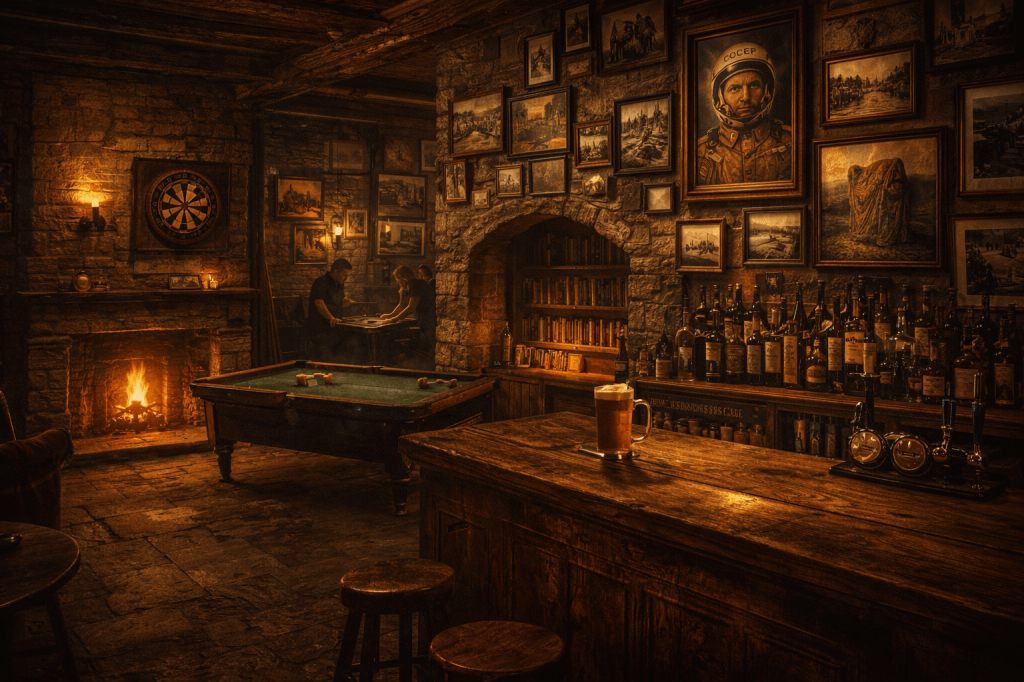
She drew a breath. Opening the door felt like opening a heavy portal to a tapestry of secret tales. The smell hit her first – whisky, beer, and peat – a comforting reminder of her grandfather’s old jacket. She hesitated for a heartbeat. As she’d hoped, the place was open, though absent of the usual noise and bustle of a busy evening. A man is cleaning the bar, a woman is moving chairs, vacuuming and singing out of tune with the kind of couldn’t-care-less attitude that must be admired. The proceeds from the Heid provided a living but not enough for the luxury of a Synth-Maid.
Internally, it was exactly as she expected it would be. The stonework is weathered to a soft grey, the kind that has soaked up generations of tobacco, smoke, laughter, and whispered conspiracies.
A real fire—proper logs with a clod of peat smouldering on top—glows in the hearth, casting amber light over the scuffed dartboard and the pool table that leans ever so slightly to one side, as if bowing to its own long service. Players from neighbouring towns knew the slope as the ‘Heid’s Tilt’ and cursed the parabola effect on crucial shots.
Photos and paintings clutter the walls, no two frames the same, most monochrome, some sepia toned, a few colourfully vibrant. Most are of the Vale across the years: weavers at their hand looms, cyclists from the 2020s, happy summer festivals at The Corner.
One picture always unsettles newcomers—an unmistakable photograph of a 1960s astronaut, visor shining, the letters CCCP clearly embossed on his flight suit, positioned in parody next to the Dagon Stone. There is no explanation of who or why it’s hung there, and the regulars aren’t inclined to elaborate.
The bar itself is a handsome old thing, a broad slab of oak darkened by time, cigarette burns and whisky spills. Behind it stands a regiment of bottles—single malts of every kind, many older than the pub’s regulars. The draught taps are polished but not fancy; the Heid has always sold good beer and sees no need to boast about it.
At the back, tucked into a quiet alcove, sits a small library. A sagging bookshelf, really, but treated with the reverence of something sacred. Its uneven rows hold well-thumbed novels, local histories, dogeared poetry collections, and a few strange titles that seem to appear and disappear over the years. Nobody admits to stocking it, but everyone borrows from it.
“Hello!” she called over the noise. “I’m Skara McCormack – I phoned last week.”
The man looks up, waves, and calls out, “Chrissie…CHRISSIE. Shut that thing down we’ve got a visitor!”
What? I can’t hear you.” She stops the vacuum.
“The journalist is here.”
Skara almost corrected him, not wanting to be associated with the endless stream of fake news that had destroyed a once respected and trusted occupation. She preferred Veritor but, keen to get off on the right foot, decided to let it slide.
“Hi, I’m Skara. You must be Gavin.”
She knew how important it was for small town folks to establish common ground and imagined the checklist ticking behind Gavin’s eyes – name, family, what school you went to and, peculiar to Scotland, salt or sauce? Some things never change.
“Glasgow, eh? Oh well, never mind,” Gavin grins. “We won’t hold that against you, will we Chrissie? McCormack, you say. There’s been a few McCormack’s in the Vale over the years. I remember a Hugh, no, not Hugh…Kerr McCormack. He was a painter and decorator and a great darts player. Seem to remember he lived in Hutcheson Drive.”
Chrissie cuts in with a laugh and offers her hand.
“Hi, I’m Chrissie. Listen to him, interrogating the poor lass. Leave her alone. She’s not even got her jacket off and he’s grilling you about your family, where you lived, and what your father did for a living. Don’t be so bloody nosey Gavin.”
“Oh, that’s ok. I don’t mind. I’m sorry but my dad was Bert McCormack, and we lived in Burn Road. He was a Social Data Curator, and we moved from the Vale to the dizzy lights of the big city for his work.”
“See”, said Chrissie giving Gavin one of her looks “are you happy now? Come. Let’s make ourselves comfortable.”
They settled around a small table near the window. The vacuum cleaner stood silent against the bar, the cleaning rag lay limp across the Guiness tap but the smell of polish and beer still hung in the air.
Skara opened her Thought Log and smiled, eager to begin. “As I mentioned when I called, I’m looking to find out more about Michael. I’m hoping you can help.”
Gavin leaned on the table, expression unreadable. “Michael? Michael who? We get loads of Michaels, Mikes, Mickeys, and Micks through here. It can be wall-to-wall Michaels some nights.”
Skara wasn’t sure whether to laugh, but Chrissie rolled her eyes before she could decide. “Ignore him. He’s an idiot. He knows fine well who you mean.” Glancing a warning shot at Gavin and turning to Skara, “We’ll help if we can. Fire away.”
Skara responded, sensing the ritual was now over. Small talk before big talk. Something she’d never fathom.
“I’m talking about Michael Strömberg, of course, trying to make sense of it all for an article. The whole thing’s…well…strange. I’m not sure yet what I’ll do with it, but as I explained last week, I think a few social history mags might be interested. Maybe Echoes or Anthrocloud. I understand it caused quite a stir at the time. It all happened last summer, didn’t it?”
Chrissie’s expression hardened.
“Aye, I can’t believe more than a year has passed. It made the national news, biggest thing to happen in the Vale for as long as anyone can remember and we had a lot of press attention for a few weeks. Though, not the kind of attention we want or welcome. Michael was a lovely guy. He had a great way about him. I still miss him. I hate not knowing what happened.”
Gavin leaned back, studying Skara with a sceptical squint. The pub’s low light caught in the glassware behind him, throwing an amber glow across his face.
“So… you don’t write for a newspaper, then? We’ve no interest in dealing with the Standard Daily. We had enough problems with them last year, twisting the truth and giving people the wrong idea. Excuse my French but they really are a bunch of lying bastards.”
Before Skara could answer, Chrissie jumped in.
“No, I already told you, you eejit, she’s a freelance writer. That means she’s independent. Nothing to do with the newspapers. Try to keep up.”
Skara gave a small smile, grateful for the rescue, and pressed on before Gavin could reload.
“It’s ok, I understand. I don’t represent anyone; it’s just something I want to do. For me, It’s not just about the story. It’s…personal. My brother disappeared in similar circumstances. Like Michael he didn’t have any troubles or enemies, he just disappeared. All I’ve got are hints and small clues as to what might have happened.”
“Oh, I’m sorry to hear that. I imagine losing a brother is awful. I hope you get to the truth and find him one day.” said Chrissie.
“I will. And I think Michael’s story can help me. I know the gist of it, but I’m looking for something a bit more…intimate. More insight into what he was really like. Anything that might shed light on the kind of person he was, where he came from and what happened to him. I understand you were close?”
Gavin nodded, his expression more serious, despite himself.
“Aye. He’d come in here every day. Wasn’t much of a talker, didn’t have much to say for himself, but he was friendly, even if he was a bit of an oddball.”
Chrissie shot him a look that needed no translation. “Don’t listen to him. He wasn’t odd. He was gentle, kind, and mannerly. Unlike most of the men around here.”
Skara hid a grin. Perhaps the real story was starting to emerge.
Gavin pretended not to notice. He leaned forward, placed his elbows on the table and fixed his eyes on Skara’s.
“Aye, he was all that. Folk liked him right away and he had a knack of getting you to tell him things. You’d start off chatting about the weather and somehow end up sharing stuff you’ve never shared with anyone before. It was uncanny how he’d get you to open. Never pushed, just tilted his head and listened.”
Skara marked her thought-log, then glanced up. “What did he look like?”
Chrissie’s face softened, remembering Michael as she liked to remember him. Remembering him as he was, not as others said he was.
“What was he like? Tall, taller than most. Slim. Blue eyes. Black hair cut short. Just a regular guy. Not sure what else I can tell you.”
Skara nodded, Chrissie continued.
“There was something steady and trusting about him. Big open eyes, a smile that made you feel seen. He laughed easy, not loud, just… warm. Found joy in daft wee things. Curious about everything.”
Skara paused her stylus. “Was he Scottish?”
Chrissie shook her head. “No. His voice had a touch of something soft, not from here. Folk guessed American, but it was hard to place. Like he’d learned English from the Vee.” She thought for a moment. “Northern European maybe – something in the way he spoke”
“Why d’you think that?”
Chrissie sat forward, placed her hands on her knees and said “One afternoon a bunch of Germans stopped – bikers, dressed in leathers and riding re–furbished BMW tourers. They called themselves Die Brenner and were on the way to meet up with the Highland Reivers. They visit every year going to the Thunder in the Glen. I remember the noise and excitement of them pulling up. Anyway, Michael was fascinated and started chatting away in perfect German. Not school phrases, full–on, natural talk.”
Skara raised an eyebrow. “He spoke it fluently?”
“Yes, as far as I could tell, but the thing is I don’t think he even realised he’d switched from English. Like the language was part of him. Mad, I know, but I think if they had been Italian or French, he’d have done the same.”
The three of them sat quiet and contemplated the thought. The fire crackled and sprayed sparks on the hearth.
Gavin spoke again, “He loved his beer.”
“Yeah? Go on.”
“He came in every day at four. An hour before the usual crowd. He liked folk but he liked his own company more. Always sat on the same bar stool.”
He nodded towards the craft beer pumps. “That one there. He’d look up at the ceiling as if divining for guidance and announce, ‘It’s a two–beer day,’ or sometimes, ‘nah… let’s make it a four today.’ He clearly thought hard about it, but I never knew what made his mind up. Mood, moon phase? I never did work it out”
Gavin continued. “Particular, though. Wanted his lager cold, glass straight with a perfect head – like he measured it. And here’s the strange bit: he wanted them all poured at once, lined up like soldiers.”
“All at once?”
“Aye. Then he’d just sit, staring at them, ten minutes maybe, not touching a drop. Like he was sizing up the best way to tackle them. Then”, Gavin mimed lifting a glass with both hands. “Down it went. The whole pint, straight through. One after another. Didn’t stop till they were all gone.”
Skara laughed. “You’re kidding.”
“Nope. I swear on my mother’s grave. He’d finish, let out a burp fit to shake the roof, and laugh like it was the best thing that ever happened. Never saw anyone love drinking beer that much.”
Chrissie had been listening, arms folded, half-smiling. His mother’s still alive and lives in Temple Street. Grave! She said.
“Aye, that was Michael all right. But it wasn’t just the beer. He always looked sharp in his black turtleneck and those burgundy trainers. Spotless, like he’d stepped out of a holo-shop window.”
She hesitated, eyes softening. “And that cap. Red, with ‘Nessie’ stitched across the front.”
Skara raised an eyebrow. “As in the monster?”
Chrissie laughed, shaking her head. “Aye, exactly that. I asked him about it once, and he said meeting Nessie was his ultimate dream. That one day he’d go up there and have a proper chat with her. Said they’d have a lot to talk about.”
She smiled at the memory, then frowned. “Like they were good friends. When I pressed him, he just muttered something about it being an honour and wanting to, what was it? Assimilate with the locals. Odd thing to say, considering Loch Ness is three hours away.”
Skara lifted her pen. “He lived in a camper van, didn’t he?”
“Aye. Another of his mysteries.” Chrissie leaned back, thoughtful. “Always immaculate hair sharp, nails clean, clothes fresh. It was one of those new but retro vans, split windscreen, two-tone paint blue on the bottom, white on top. We never saw inside, but I doubt it had a shower, never mind a toilet.”
“Did he stay nearby?”
“At first, he parked in the Ranoldcoup Road but, after the kids started teasing him, he had to move into Lanfine Woods. Stupidly it started as a joke. Just a daft joke.”
Skara felt an unexpected flicker of unease. Chrissie was perceptive. She paused a moment too long. An ash log collapses, sending up a shower of amber. She blinked and rubbed her eyes.
“Sorry, I’m not used to fire smoke. What do you mean by jokes?” she asked, keeping her voice even.
“It was nothing really”, said Chrissie “Michael had this thing for knock-knock jokes. Couldn’t get enough of them. He’d ask anyone to tell him one, even stop strangers in the street and say, ‘Tell me one.’ Then he’d roar, a proper belly laugh, even at the daftest punchlines. Sometimes he’d just cut into mid-conversations and say, ‘Knock-knock,’ like it was a reflex.”
Gavin joined in, shaking his head. “At first it was funny. Then – side-eyeing Chrissie – it was odd. People thought he had Tourette syndrome. It got too much. I always thought he did it when he didn’t want to answer something.”
“What do you mean?”
“Well, when you asked anything personal, like family or football or where he came from.”
“Did he ever say?” Skara asked.
Gavin rubbed the back of his neck. “Once. I asked where he was from and he said some gobbledegook like ‘my past is past; my future’s still to be coded.’ Sounded like a line, but I could tell he meant it. I don’t think he knew much about his past- or maybe he’d decided not to tell. Anyway, he was obsessed with those stupid jokes – the worse they were, the happier he was.”
Something in Gavin’s voice made her lean in. “So… what happened?”
Gavin drew a long breath, his eyes narrowing as if the memory stung.
“As I said he asked everyone for those bloody jokes. Then he started inventing his own. Folk thought he was daft, but harmless. Most entertained him and laughed along. Then the teenagers got hold of it. Started calling him Mr Knock-Knock. Shouting it when he walked by, spraying it on his van. A stupid nickname that stuck. You’d hear it echoing round town – knock-knock… who’s there… Mr Knock-Knock.”
He stopped, staring at nothing for a moment.
“It went on for weeks. Then one night they went too far. A gang surrounded his van. Sticks banging. Pebbles hitting metal. Laughter. Taunting. No way out. Maggie Allan was walking home from a neuro class and saw it. Said Michael was rocking back and forward, hands clamped over his ears, making a strange guttural sound that developed into a scream.
Gavin sipped his coffee.
“What I can tell you is that Maggie Allan is a tough woman unafraid of anything that walks, flies or swims but she said that Michael scared the living daylight out of her. To the point that she almost passed out.”
Chrissie picked up the thread.
“Maggie did manage to control herself, thank God, and summoned the Watchmen who were on their way anyway. But before they came, the damage was done.”
She looked at Gavin, then back at Skara. “They fell onto their knees. The kids went down clutching their ears, faces contorted, blood running between their fingers. Some screamed like it was their last. It was over in a few seconds. Most of the kids lost control of their bladders. Their jeans darkening as they pissed themselves. Maggie said she felt sick at the sight of it all.”
Skara felt the muscles in her stomach tighten. “What happened after?”
“A dispersal drone arrived on the scene and then the Watchmen” Gavin said. “They took statements, strutted around with the self-importance we have become accustomed to and after all the recording and note taking was complete wrote it off as a stupid prank that had turned into group hysteria. Said the kids had been drinking, winding each other up. Nobody wanted to believe the horrors that Maggie reported.”
Chrissie nodded. “Maggie was fine. No bleeding, no pain, bladder in perfect working order as far as we know. Not that she’d admit to anything else. Only the kids were affected. It was as if…as if he chose who to hurt.”
Skara looked up sharply. “Targeted?”
“How else would you explain it? The ones screaming with bleeding ears were taken to hospital. The rest went home, white-faced, damp and stinking of piss. Michael didn’t show up here until the next day and said, ‘Today’s a six-pint day.’ That was the one and only time he did”
“Jings” said Skara.
The three of them sat in the hush that followed. The only sound was the whoosh of a passing Transitron – a reminder that the world outside was unchanged even if the atmosphere inside the Heid had flipped to surprise and disbelief.
Skara asked, “Did he ever work? Even odd jobs? He wouldn’t have needed much – fuel, insurance, that sort of thing.”
Gavin shook his head. “Never saw him lift a finger. No side gigs, no favours. He seemed just … content to live in the moment. Didn’t even carry a Muse, as far as I know. Come to think about it I never saw him with any tech. He’d spend days wandering the fields round the Vale. Folk noticed, of course. Thought his behaviour a bit strange. Stories started – said he hugged trees, built fires, danced naked under the moon.”
He gave a half-smile. “I never saw any of that. But I did see him by the river once, sitting on the bank. Picking up stones, turning them over, sniffing them, putting them to his ear, licking them – like he was reading something the rest of us couldn’t see.”
Chrissie’s voice came softer. “He was different, aye, but he was never dangerous. I used to think he was halfway to being an angel. God, I wish he was still here.”
Skara blinked and her Thought Log turned another page. “Did he ever show interest in anything besides nature?”
Gavin frowned, thinking. “Yes, once. I came up from the cellar and found him staring at the Vee. Some daft news story about an asteroid on course to wipe us all out – bigger than Manhattan, two-point-something percent chance of impact. You know the sort of thing. Dramatic music, a serious sounding scientist and a sober assessment of the likelihood of an extinction event. The sort of thing they run when nothing else is happening.”
He gave a small shake of the head. “None of us paid it any attention but Michael looked… rattled. Not like him. Then the scientist said the strike – if it happened – would be about two years off. You could see Michael doing sums in his head. I think he was plotting trajectories, calculating impact force, that kind of thing. Then he just stopped, breathed out, and muttered, ‘That was close’ and said, ‘It’s a two-pint day’. First and last time I ever saw him worried.”
Chrissie looked concerned. “You know, we liked him, thought the world of him really. He was always gentle, polite, no edges, no bitterness. I don’t know where he came from, but I never doubted he was good. If anything, he was misunderstood. We don’t want him pilloried through the press again.”
Skara nodded. “I’ll make sure that doesn’t happen. I’m not here to drag up dirt or to attack Michael – I just want to tell it straight.” The heaviness hung for a beat, so she shifted to a more upbeat tack. “I heard he once saved someone’s life?”
Gavin’s eyes flicked up. “More than one. Happened right outside The Corner. Dangerous junction – transits and movers often parked both sides. A self-drive pulled out too soon and hit an eWagon. It tipped, rolled across the road, and ended up facing the Railway Inn. A crowd soon gathered from The Corner where they had been watching the time-capsule opening ceremony.”
“The time capsule?”
“Yes. It was buried back in 2023 with the instruction not to be opened for fifty years. Everyone was excited to see what it contained. Turns out there was some old photographs, papers, computers and second-generation iPhones. The best bit was that primary school age kids had sent letters to their future selves. Some had gathered, eager to see what hopes and aspirations they had for themselves. Some, of course, never made the opening ceremony, many killed in the war.
“Who buried the time capsule”
“Some well-intentioned volunteers of the time. The took a video of the burial ceremony that’s been turned into a Holo-Vid. I bet they never imagined that their holo-person dig it up or that the opening ceremony would be so dramatic. Just as the capsule was revealed there was an almighty crash. It was carnage. Passengers were trapped, the cab smoking and close to flames. Of course, everyone ran to help”
Skara grimaced. “Oh God, that’s awful.”
“Yes, but it could have been much worse. Lars Nyström was coming out of the Railway. Claims he saw Michael appear – just appear – and rip open the roof with his bare hands. Pulled the passenger out before the flames spread.”
Chrissie gave a dry laugh. “Right. Lars has interesting pastimes and is known to see things that aren’t there.”
“Aye,” Gavin said, “but this time… maybe not. No one else saw it happen, and Michael denied it. But the roof was torn clean off. And, by some miracle, the passengers were found in the recovery position behind the vehicle. I was standing right here pouring pints when it happened. Missed all the excitement. Next thing, Lars is in here shaking, mumbling incoherently and ordering double whiskies. I was about to tell him he’d had enough and should go home when I realised something bad had happened.”
Skara took a moment. Outside, a strengthening wind pressed against the windows. The Vale darkened as black clouds sped in from the west. For a while none of them spoke – each turning over their own idea of who, or what, Michael Strömberg really was.
Before the silence became awkward Skara said, “It sounds like Michael was…well, it sounds like he’d become a bit of a local celebrity.”
Gavin gave a lopsided smile. “Aye, you could call it that. People did talk about him, but his hero status didn’t last long. At first, he had been the funny, cute guy who liked to make annoying jokes; then he was the Faerie King who communed with nature and summoned spirits in the woods; and then he was the caped hero with superpowers. Through all this people like him well enough but that was about to change.”
“What happened?”
“The river business happened”
@ Copyright 2026 Steve Gillies. All rights reserved.
 Steve Gillies
Leave a comment