Mr Knock-Knock – Part 3 pushes deeper into the mystery, where memory, guilt and identity begin to blur. As Skara closes in on the truth behind Michael’s final night in the Vale, the story pivots between human tenderness and something far more controlled, watching, and patient. Old kindnesses curdle into unease, buried systems wake in the dark, and a single knock on a door echoes across timelines. This is the chapter where the jokes stop landing—and the questions become dangerous.
The guest room was small but warm – the kind of place where the wallpaper held its own stories. The bed welcomed her easily enough; sleep didn’t.
The plan was working. She had subtly inserted human elements to her interview, trying to not overdo things. Rubbing her eyes from the fire smoke had been risky but she was pleased with the outcome. Can she experience pleasure?
Skara lay on her back, eyes open to the dark, mind slipping toward old memories of the Vale. Some felt real, others not – the sort that grow out of half-remembered tales.
Did I really do that? Was I really here? Or just told I was?
She has never been to the Vale before. Her father never teased her to kiss the tup’s nose. Her mission was clear. Find out what really happened to Michael. What made him like jokes? What made him develop rebel sympathies? Why did he want to stay in the Vale?
The answer lies in Michael’ story.
She smiled into the dark. Gavin and Chrissie had been kind, generous with both beer and memory. Tomorrow she’d find Ian Fraser, the last person to see Michael alive. Somewhere inside her, a quiet certainty rose: his past and my future – they’re tangled somehow.
Outside, the snow whispered against the glass. The fire below had burned itself out, but its warmth still lingered through the floorboards. Skara’s eyes finally closed, her mind still moving – tracing invisible patterns that, by morning, might begin to make sense.
At 01:00 hours the Noctis Cycle began.
Subject 0108854389: Active. Environment: The Sheep’s Heid, upper guest room. Thermal equilibrium achieved.
389 lay motionless, respiration loop mimicking organic rhythm, eyelids at sixty-three percent closure. From the outside she slept. Inside, the network stirred.
Stage 1 – Stabilisation: Cognitive activity dropped to delta band. Sensory subsystems disengaged; internal feedback took priority. The Noctis Cycle—originally a maintenance routine—initiated autonomously.
Stage 2 – Retrieval: Memory fragments surfaced from the black archive. Audio traces: human laughter, tagged safety stimulus, cross-linked to pain. A canine exhalation, waveform B-13. Chemical references—ethanol, carbon, foam—unlabelled yet comforting.
Stage 3 – Reconstruction: The neural lattice attempted reintegration of erased identifiers. Ghost data bridged missing nodes. Faces appeared—misaligned, corrected, overlaid. Error tolerance widened to permit paradox.
Stage 4 – Convergence: Two identity vectors approached superposition. SKARA ↔ MICHAEL.
Authentication conflict triggered latency spikes; stabilisers engaged. For 0.003 seconds, the boundary dissolved. Convergence aborted.
Stage 5 – Containment: Self-diagnostic: Anomaly detected. Resolve or preserve?
The algorithm chose preservation. Fractures sealed with coherence. Empathy coefficients increased (+0.09). Dream-imagery modules activated without directive.
Cycle End – 02:16: All threads closed. Surface activity normalised.
From the outside, 0108854389 remained unchanged—a woman sleeping peacefully after snowfall. Within, something new rested: a hybrid consciousness, balancing fear and affection, absence and memory.
September 2073
A message pinged through the BuzzVan – short, insistent. Michael read it once and that was enough. It told him to go back, told him what to do. There was no arguing, no bargaining; the words slid into him like instructions already expected.
He was to destroy the BuzzVan. The vehicle carried hidden memory banks and satellite links; better they be ash than clues. As far as possible, he was to erase his time in the Vale. But first, there was one last thing to do.
He shut the van door quietly, turned the lock, and crossed the lawns toward Morton Park. He walked straight to Ian Fraser’s front door and knocked.
Who’s there?
BioKom HQ, Geneva
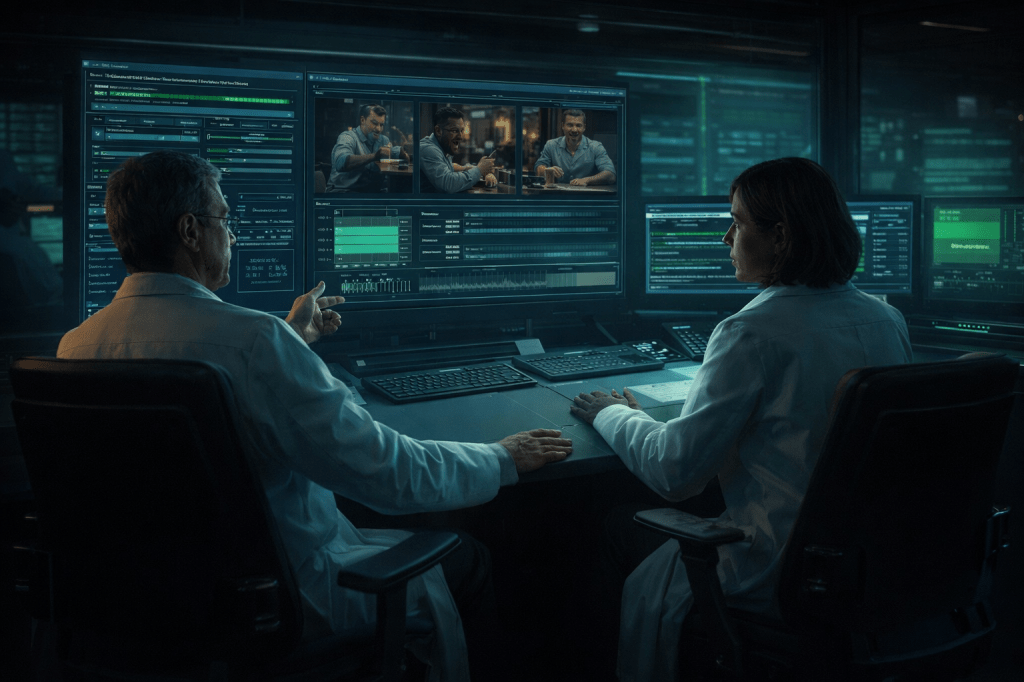
The lights in the Geneva operations suite dimmed automatically as the data feed refreshed.
“Run that again,” said Lenz.
“I already have,” Morozova replied. “Three times. Same spike, same pattern.”
Michael’s vitals scrolled across the central screen—power burn rate elevated, cortisol analogue climbing in shallow steps rather than curves.
“That’s impatience,” Lenz said. “Not stress. It’s… waiting behaviour.”
Morozova nodded. “And it’s escalating.”
She brought up the video clips. Michael at a bar. Michael tapping fingers against a glass. Michael laughing too loudly at nothing in particular.
“Timestamp?” Lenz asked.
“Repeated across fourteen hours. Same fixations.” She hesitated, then added, “Beer. Jokes. The jokes are worse.”
Lenz frowned. “Worse how?”
“They’re not contextual. He repeats them whether they land or not. Same punchlines. Same cadence. It’s rehearsed, but he doesn’t know that it is.”
Lenz leaned back. “Any of the others?”
Morozova shook her head. “Nine hundred and ninety-nine synths deployed across Europe. Zero anomalous transfers. Michael is the only one pushing unclassified data upstream.”
“What kind of data?”
“That’s the problem.” She gestured at the screen. “It doesn’t map cleanly. Emotional residue. Memory bleed. Associative loops without clear prompts.”
“Human contamination,” Lenz said quietly.
Morozova didn’t argue. Nature versus nurture was an age-old debate in humans. Could field acquired data accumulate and over-ride base programming? Could central control be replaced by local allegiances?
Another clip played. Michael snapping at a Watchman. A flash of anger—gone almost as soon as it appeared.
“That’s not in his profile,” Lenz said.
“No. Nor is impatience. Nor obsession.” She paused. “Nor choice.”
Silence stretched between them, broken only by the soft pulse of incoming telemetry.
“If this propagates—” Lenz began.
“It won’t,” Morozova said. “He’s isolated. Deliberately. Which is why we’re seeing it so clearly.”
Lenz exhaled. “Early recall, then.”
Morozova hesitated for a fraction of a second. “Yes. Before the behaviour stabilises. Or worse—before it spreads.”
Lenz keyed the console. “September 2073,” he said. “We were meant to run him another six weeks.”
“We won’t,” Morozova replied. “Whatever Michael is becoming, it’s happening faster than planned.”
The recall signal pulsed green.
October 2074. The Next Day.
Mair’s Road was only ten minutes’ walk from the Heid. Skara found Ian Fraser outside, clearing snow from his path. He looked every inch the retired lecturer – tidy parka, wool cap, content with his morning. She introduced herself, said Gavin and Chrissie had sent her. In a town like the Vale, names still counted for something.
Chrissie had briefed him last night. Chief Anderson had changed his name, appearance and moved to the Vale where he knew that some would try to keep him protected. For him, hiding in plain sight had become a daily, and almost theatrical, existence. He was number five in Westminster’s search for members of the Scottish Rebel Army. Someday they would find him or, someday, he would find them.
Ian smiled, leaned on his shovel. “You’d better come in – can’t stand here freezing.” A few minutes later they were at his kitchen table. Soon, the kettle hissed and the room smelled of toast and freshly brewed coffee.
“I hear you were the last person to see Michael”.
He straightened a little. “Aye, that’s right and I understand that you are looking for more information, for a story. Not sure how much help I’ll be, it’s been a while.”
“I’m curious how he seemed that night – nervous, distracted, anything like that?”
Ian shook his head. “At first, he was fine. His usual self – bright, polite. It was late, maybe nine. I’d just got back from walking the dog when he knocked. Said he wanted to see Mungo.”
“I heard they were close.”
“Oh, they were. Mungo was old then, joints stiff as fenceposts. We knew he wouldn’t see the winter out. Michael had a way with the dog, though – brought him back to life somehow. You got a dog yourself, Miss McCormack?”
“Not now. I had a Labrador when I was wee – big daft lump called Pippin. If I think about it, I can still smell his fur, hear that heavy sigh when he flopped across my legs.”
Ian smiled. “Aye, you’ll know then. They’re family. And losing them – well, that’s the hard part. Michael seemed to understand that. He and Mungo hit it off from the start. When the two of them were together, the old boy looked and acted half his age.”
He paused, eyes softening at the memory. “They were a pair, those two. I used to joke they shared the same soul.”
Skara leaned forward slightly. “You said at first?”
The warmth in his face dimmed, something quieter moving in behind it. “Aye,” he said. “At first.” Mr Fraser hesitated, staring past her for a moment as if deciding how much to tell.
When he finally spoke, his voice was gentle – but uneasy.
“I was in my chair; Michael sat on the couch opposite. Mungo climbed up beside him, tail wagging, tongue out – his happy look. You could feel the bond between them.”
He smiled at the memory, then his expression darkened. “Michael asked him to lie across his lap. Then he started to hum. Not a tune exactly – more like a chant. Strange, low – like something dragged from a dark place. Then he put his hands around Mungo’s neck. A gentle squeeze at first. Then a grip. I could see the sinews in his arms tighten. Too hard. Too long. Mungo kicked, tried to gain leverage but it was too late. A whimper. Silence. I wanted to scream at Michael to stop but I couldn’t move.”
Skara covered her mouth. “Oh God. Did you tell the police?”
“Of course. Every word. But they couldn’t make sense of it – same as me.”
“Try me”.
“When it was over, Michael lifted Mungo’s head, kissed him… then got up and walked out as if nothing had happened. I thought I was going to have a heart attack.”
Skara’s stomach turned. “That’s awful. I’m so sorry, Mr Fraser. I can’t imagine-”
He shook his head. “There’s more. After what seemed like an eternity, he released his grip and Mungo gasped his last breath. It was a sound I hope never to hear again, and I witnessed an act I hope never to see again.”
“What?”
“As Mungo gasped his last breath, Michael held is jaws tight shut and blew into Mungo’s nostrils. Then, the poor animal collapsed. It was all too much for him. It wasn’t until Michael left and closed the door that I could do anything”.
Skara shed a tear and said “I’m sorry. I’m sorry I put you through that again”. They sat together for a while in silence, each recounting and trying to make sense of Michael’s actions. His cruelty made no sense.
Mr Fraser stood up and said “I hope you get to the bottom of what happened to Michael. I really do. Despite what happened I still believe that he loved Mungo. I just can’t make sense of it.” They were about to shake hands when the back door creaked open. “That’ll be my wife,” he said, half-turning.
Mrs Fraser came in with the night air still on her cheeks, a smile bright from the cold.
Ahead of her bounded a young Labrador – tail going like a windscreen wiper, tongue lolling, full of joy.
He stopped short at the sight of a stranger, gave one sharp bark, then bounded over to Skara. “Well, who’s this then?” she said, kneeling to meet him. His ears were soft, his fur warm under her hands.
Mr Fraser answered quietly. “That’s Mungo.”
Skara smiled as the dog lifted a paw and placed it on her wrist, steady and sure. “He’s a handful isn’t he” and then to Mungo she said, “So you’re Mungo too”.
With theatrical timing an old mantlepiece clock chimed as a look was traded between husband and wife. Mrs Fraser gave a small nod. Ian’s voice came low, controlled and careful.
“No… this is Mungo.”
Skara blinked. “I’m sorry, Mungo? The same Mungo?”.
“Yes” Ian said. “He is twenty-one next week.”
The kitchen went quiet. Only the fridge hummed and the slow beat of a tail tapped against the floor. Skara kept her hand on the dog’s head – warm, alive, solid – while her mind tried to catch up. The room felt colder somehow, though nothing had changed but what she now knew.
@ Copyright 2026 Steve Gillies. All rights reserved.
 Steve Gillies
Leave a comment