Birthday Greetings (From The Past) is a chilling literary tale for anyone who has ever felt the past lean a little too close. On his birthday, a short story writer attends a talk about Edgar Allan Poe’s childhood in Irvine, Scotland — only to discover, later that night, a child’s voice hidden beneath his recording. What begins as curiosity becomes something far stranger when his own manuscript rewrites itself in a voice not entirely his own. Atmospheric, intelligent, and quietly unsettling, Birthday Greetings (From The Past) asks: what if memory does not fade — but waits?
It’s the day after my birthday. No big deal. Just one of well over sixty and hopefully one of many to come. I’m at an age when it’s best to ignore birthdays in the hope that if I don’t acknowledge them, time itself might do the same.
However, yesterday was different. I was excited.
I’m a short story writer. It’s a hobby. Not famous (I wish). Not obscure. Somewhere in that broad middle ground where stories get written because they insist on being written. My wife knows I’ve admired Poe since I was a teenager — not just the gloom and the theatrics, but the precision of his sentences. The control. The inevitability. The ‘what just happened’ surprise at the end.
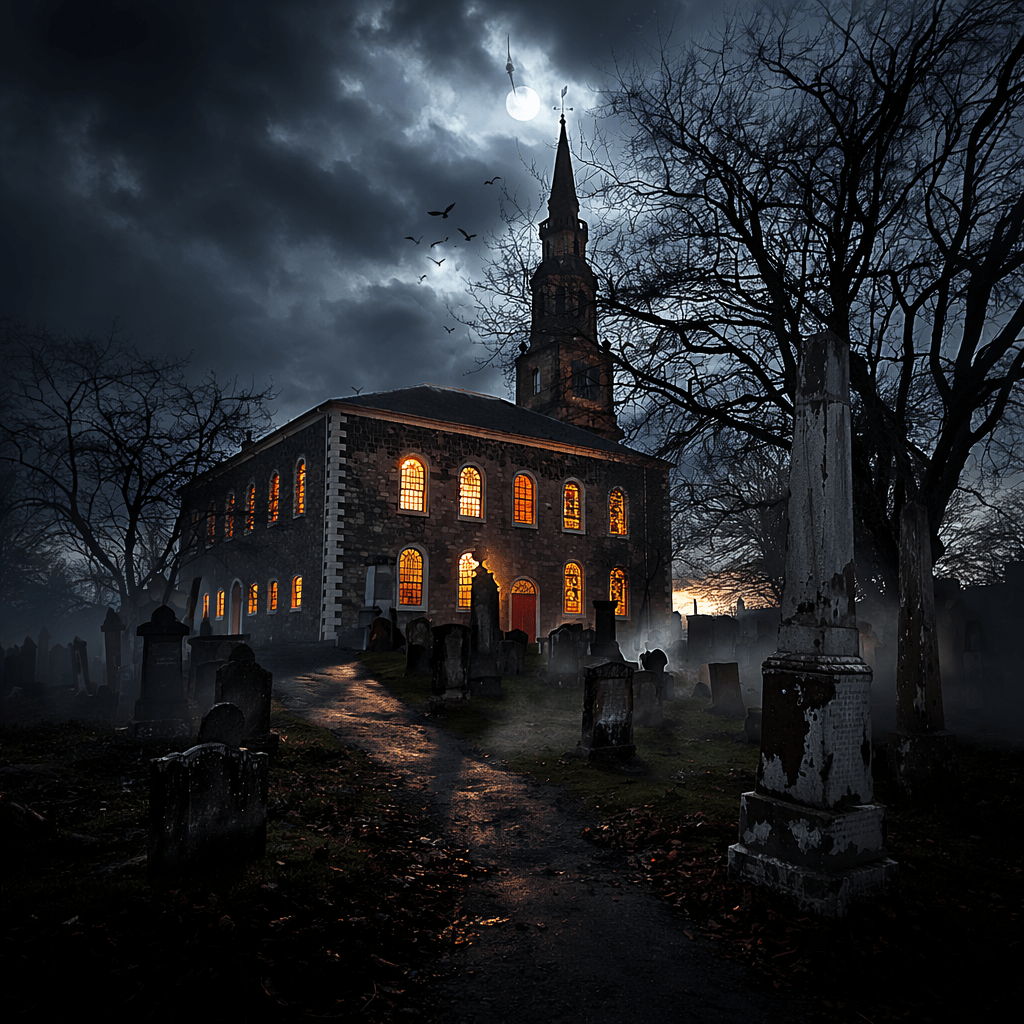
She had found a local talk on Edgar Allan Poe by the curator of the Poe Museum in Baltimore. We gathered at the graveyard of the Irvine Old Parish Churchyard. Warm jackets, waterproof footwear and torches were required. Later we gathered at the Port Head Tavern for talks, conviviality and a few drinks.
It was my birthday. A talk on Poe. Unbelievably, just twenty minutes from our home. It was too good an opportunity to miss.
It turned out to be a most pleasant evening shared with new friends – poets, writers, local historians and Poe enthusiasts. When we got home, I scribbled a short memory of the evening.
You will see that events turned out very different from what I expected. Very different indeed. As is my habit I drafted a story based on the event when I returned last evening. This morning, over coffee, I read it.
*****
It was upon the evening of my birth anniversary—an observance I had not anticipated passing in communion with the long departed—that I found myself within the ancient parish graveyard at Irvine, beneath a firmament the colour of embers long extinguished, yet not wholly cold.
The air possessed that peculiar Ayrshire chill which is less a matter of temperature than of recollection: a remembered cold, rising stealthily from stone and sod, insinuating itself into the marrow.
A modest company had assembled to receive an address concerning the early years of Edgar Allan Poe, who, in the fifth and sixth circuits of his brief existence, had dwelt for a season in this very town. The circumstance lent the ground a tremulous significance—as though the soil, once pressed by the uncertain tread of a child, retained some faint impress of his passage.
The speaker, curator of the Poe House in Baltimore, stationed herself near the kirk wall and discoursed with a gentle yet measured authority upon the boy’s Scottish sojourn—upon impressions gathered ere language had matured sufficiently to confine them; before intention could be shaped into utterance; before thought acquired its habitual discipline.
“At that age,” she observed, “memory is not narrative. It is sensation. Dampness. Sound. The manner in which the light withdraws too soon. The way an Ayrshire darkness appears darker than any other. Such things endure long after events have dissolved.”
I confess that I preserved a portion of her discourse upon my phone—not from piety, but from custom. It seemed an apt reliquary for an uncommon birthday. The wind disturbed the yew branches overhead with a sound not unlike a distant whisper. Beyond the wall, a gull emitted a brief and cutting cry, as though in protest at our intrusion.
The curator proceeded, remarking how little of Scotland Poe consciously retained, and yet how certain tonalities—the melancholy of bells, the intimacy of burial grounds—might later have found their sombre efflorescence in verse and tale.
As we made our careful way betwixt gravestones carved with masted ships, coffins, skulls, crossbones, and winged hourglasses — lest we stumble and break a neck — faint epitaphs emerged beneath squinted eyes. Memento mori.
When the address concluded, we repaired, in accordance with civilised usage, to a neighbouring public house. There were warmth and illumination; the agreeable tumult of glasses and voices; the soft collision of anecdote and speculation. The gravity of the kirkyard yielded to conjecture and mirth. My wife, diverted by the singular romance of the occasion, proposed a toast “to childhood—and to survivals.” Laughter responded in ready assent.
At one juncture I replayed a brief extract of the recording for a fellow attendee. The room being loud, I held the device near his ear. He inclined his head courteously at the curator’s measured tones and returned the instrument without comment. If any irregularity intruded upon the sound, I did not then detect it. Nor did my companion, who would assuredly have remarked upon so singular a disturbance.
It was not until our return home—when the house lay hushed and the hour had advanced into that ambiguous territory between night and introspection—that I listened anew.
I do not habitually employ headphones; yet some impulse, faint but insistent, compelled me. Whether it was the lingering solemnity of the graveyard, or merely a desire for clarity, I cannot determine.
The recording commenced as expected. The curator’s calm cadence; the soft abrasion of wind against the microphone; the distant hum of traffic beyond the wall. I recognised my own discreet cough near the outset. Then—subtly—something beneath.
At first, I attributed the anomaly to distortion: a tremor in the audio; a coincidence of overlapping frequencies. But as I adjusted the volume, the undercurrent resolved itself—not into static, but into articulation. A second voice. Low. Hesitant. It bore the unsteady respiration of a child unaccustomed to shaping speech for the comprehension of others. It did not interrupt the curator; rather, it subsisted beneath her utterance, as though the earth itself had discovered some narrow register within the device.
“…cold…”
The word was scarcely more than an exhalation.
“…the stones are cold…”
I remained motionless. Above, the curator spoke of early nineteenth-century Irvine—of modest dwellings and mercantile prospects. Beneath her: “Mother?”
The syllables were extended—not in anguish, but in inquiry. I removed the headphones and sat without movement. The chamber was entirely ordinary: the mantel clock announced the half-hour with habitual precision; the heating emitted its familiar sigh. There was no sensation of presence—only the reverberation of what I had heard.
I recommenced the recording from its inception.
Again, the superimposed voices.
“…why is it dark so early?”
“…the bell frightens me…”
At this I found myself compelled—irrationally, perhaps—to examine the file’s timestamp. It displayed the proper date and hour, in strict correspondence with the address at the graveyard. The metadata revealed nothing untoward; the waveform appeared unexceptional.
I listened onward. The child did not speak continuously, but in fragments, as impressions rise and subside like breath upon chilled glass.
“I shall not remember…”
A pause. “They say I shall not remember.”
At that precise juncture the curator, unknowing, discoursed upon the limitations of juvenile recollection—how memory at five or six rarely survives in structured form.
The child’s voice—faint, yet distinct: “I do not wish to stay.”
There ensued a gust of wind across the microphone, and then only the curator’s closing sentiments; the courteous applause; the abrasion of shoes upon gravel. The recording concluded. I played it again—then yet again.
The words did not vary. They were neither caprice nor hallucination; they possessed consistency. Yet I cannot affirm that they were external to myself. It is entirely conceivable that expectation, suggestion, and the peculiar susceptibility of anniversaries conspired to fabricate what I believed I heard.
The human mind, when sufficiently provisioned with atmosphere, is capable of manufacturing its own apparitions.
And yet—
There remains one final particular which I scarcely dare commit to paper, for it may signify nothing. As I removed the headphones for the last time, I apprehended—not by sound, but by some interior cognition—that the voice had altered. The final fragment, almost submerged beneath the curator’s valediction, had not been present in my earlier hearings.
It was softer than the rest.
“He is listening.”
A breath.
“He thinks it is his birthday.”
I have not since replayed the file. It resides still upon my phone; its timestamp remains correct; its waveform betrays no anomaly. Yet this very evening, as I passed before a mirror in the dim corridor light, I experienced a singular and fleeting impression—not of age, nor of resemblance, but of proximity.
As though somewhere, beneath the orderly sediment of my own remembrance, there lay impressions not wholly mine. Cold stone. Failing light. A bell sounding too near.
It may be that childhood never wholly relinquishes us—that what we fail to remember nevertheless retains its memory of us. I cannot determine the truth of it. I know only that when I stood within the graveyard at Irvine and later raised my glass amid warmth and fellowship, I believed the past to be securely concluded.
I am no longer certain that it is.
*****
For a while I sat staring at my coffee, now cold. What strange murkiness lay within?
“Katie,” I shout. “Come and see this”.
I explained how I had drafted a tale based on our evening including the odd business of the child’s voice. I show her my draft.
“It’s in old English”, she said. “Well done. It gives it authenticity”.
“I didn’t”.
“You didn’t what?”
“I didn’t write it in old English. Did you change it overnight?”
“Of course not,” said Katie. “Check the document metadata”.
I right clicked, selected ‘Get Info’ and scrolled down to general information.
Kind: Microsoft Word document (.docx).
Size: 19,324 bytes.
Created: 26th Feb 1850. Location: Baltimore.
@ Copyright 2026 Steve Gillies. All rights reserved.
 Steve Gillies
Leave a comment