Deployed to a small Scottish town known as the Vale, Unit 0108854389 — Michael — did more than assimilate. He told knock-knock jokes. He drank beer. He loved an elderly Labrador named Mungo. He defended himself when threatened. He made a choice.
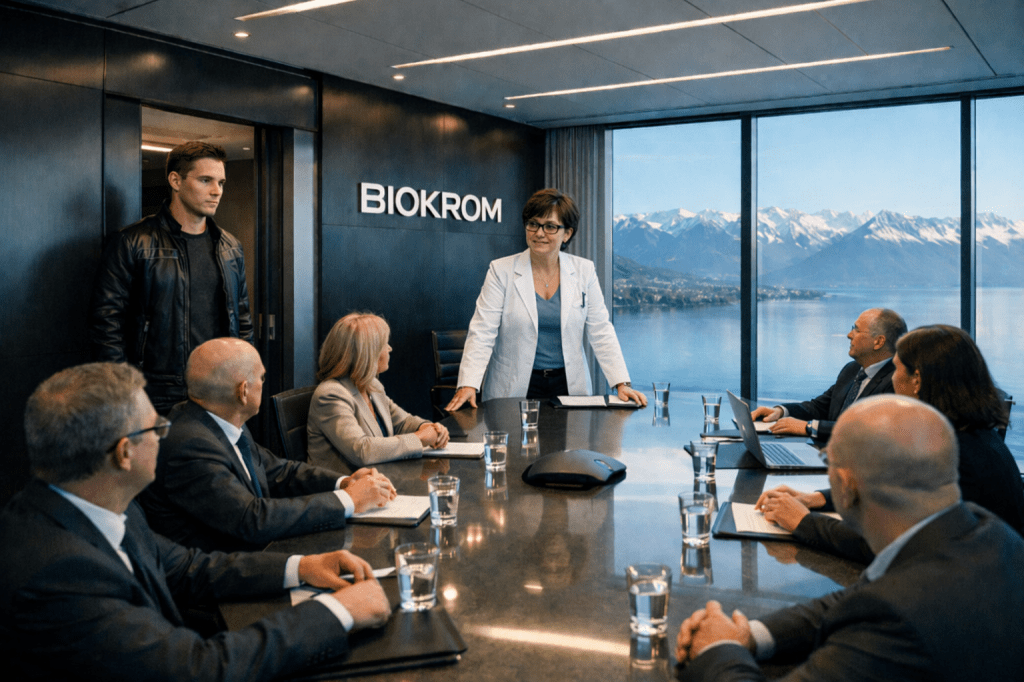
January 2074. Geneva.
To the north, Mont Blanc hovered in the haze, its summit catching what was left of the sun – a weak coin of light that never quite broke through. Drones drifted between the towers, silent and steady. Far below, traffic moved under a blanket of mist. Markus smiled at the giant holographic advert floating high over the lake. ‘Toblerone. Lose Yourself’ perfectly positioned as the gateway to the alps. “Some things never change,” he muttered to himself.
Inside, the air was too warm and clean. He pressed a button and the walls shimmered faintly, adaptive glass turning daylight into a sterile whitewash. A long obsidian table ran to the window like a blade, its mirror-black surface reflecting a line of faces – scientists, investors, their Muses flickering above their wrists like tame ghosts.
Most were whispering into their private feeds, muttering numbers or listening to their digital advisers. On the far wall, a clock marked perfect seconds – unnecessary, given BioKron’s network already timed every meeting to the millisecond.
Only two sounds broke the silence: the hush of the environmental filters and the soft tap of Bachmann’s fingers against the table – a slow, restless rhythm in a room engineered to erase human noise.
He was waiting for the results from Anima Field Test #2 – Europe. Numbers that would decide the company’s next twenty years. And his own place in BioKron’s history.
The American trials had been small – cautious – but they’d worked better than anyone dared hope. Investors swarmed, stock jumped, and within a week BioKron was swimming in new capital. Europe came next. Faster, bigger, riskier.
A thousand humanoid units placed into everyday life – teachers, carers, clerks, neighbours – to see if they could pass as human, unremarked.
Markus Bachmann had been with BioKron almost forty years. Long enough to watch the company shed its skin more than once – from the age of obedient tools to the age of manufactured souls. He could still remember the old MK Series of the 2030s: chrome limbs, perfect servitors. Machines that could lift a man but not look him in the eye. Brilliant, cold, and hollow.
Then the SYN Line – the Synthetic Nexus project of the fifties. Flesh that sweated, lips that flexed, laughter modulated in forty-three tones. The goal – twenty-three degrees of freedom in a robotic hand – had at last been achieved.
They looked human, until they spoke. The world called them the Uncanny Generation. Investors called them a windfall.
Bachmann’s own legacy came in the sixties: the VERA units – Verisimilar Adaptive Robotics Architecture. Even the name was a mouthful. They could teach, soothe, even smile back at you just right. People wanted to believe. But belief was all it ever was. Behind the eyes sat nothing but probabilities – mimicry so refined it felt like truth.
And now there was Anima. His project.
Not behaviour this time, but response. Not programming emotion but building the perfect imitation of it – so seamless even the engineers might forget it was an act. A thousand Anima units released quietly into Europe. Every one of them flawless.
Except one.
*****
The boardroom’s light was diffused but alive – a slow pulse of colour that breathed with the people inside it. Halo hung just below the ceiling, a translucent ring of photonic glass that shimmered in perpetual motion. At rest it glowed a calm aquamarine – BioKron’s registered shade of consensus – but its hue was never still. Each flicker, each shift in tone, came from the collective data streaming in from the attendees’ Muses.
Every fed its host’s biology into Halo: pulse rhythms, ocular focus, micro-fluctuations in dermal temperature, even the dilatation of pupils as conversation sharpened or stalled. The system parsed it all, translating the invisible weather of the room into light.
When calm prevailed, the ring stayed blue and steady, humming softly like breath. When tension rose, the glow deepened toward violet. When someone lied, the change was unmistakable – a ripple of red that tremored through the glass like a heartbeat skipping a beat. Reading a room had become less art and more science.
For investors, it was a symbol of transparency – a promise that emotion itself could be audited. For the engineers, it was feedback: a barometer of trust, coded in colour. But to Bachmann, who had watched too many trials turn from hope to failure, Halo felt like judgement. It saw everything, felt everything, and offered no privacy. Beneath its gaze even apathy had a pulse.
The walls mirrored Halo’s shifting tones, casting subtle reflections across the table and the faces gathered round it. Data shimmered on glass surfaces, their skin tinted by corporate emotion – serenity one moment, apprehension the next. The air filters whispered, the Muses ticked quietly on their hosts’ wrists, waiting for data.
The glass doors slid open. Dr Mara Bernasconi, Head of Data Analysis, entered with her team close behind – calm, efficient, unhurried. She moved straight to the head of the table and touched her Muse. The device flickered to life, then dimmed again as she set it to listen-only.
No introductions. This was Switzerland; precision came before pleasantry. Chairs slid across the polished floor, the sound sharp and even, like measured breathing. Bernasconi looked up.
“Good morning. I’m pleased to confirm that Project Anima – Field Test Number Two: Europe has concluded successfully. All one-thousand testing units have been recalled to Geneva. Data analysis is complete.”
A colleague tapped a control. The walls brightened with flowing columns of light – data streams shifting like a tide.
“Just to recap,” she continued, “the goal was to evaluate cultural assimilation. Each unit lived for three months in a European town or city, recording every human interaction. That data has been parsed and categorised. We’re now ready to present a summary of findings.”
Across the table a hand went up – Gerhard Schneider, one of the major investors. Bernasconi drew a breath. Schneider was known for turning questions into autopsies.
“Yes, Herr Schneider?”
“Were all the units identical?”
“Yes. ANIMA-203s. Latest firmware.”
“And their operating system?”
“All running Lugano Version 8.2 – released in May. It’s our most stable build yet. The AI core is our fastest yet – learning from real-world input captured through embedded sensors and cameras at speeds thought impossible only last year.”
She paused, letting the words settle. Around the table, augmented displays shimmered in the lenses of her glasses like small constellations. For the first time that morning, Bachmann exhaled. The report had begun.
Schneider leaned forward. His voice was quiet, but every word was heard. “And offensive capabilities? Were they active?”
Bernasconi paused. She knew the answer – she knew all of them – but saying it out loud was another matter. Schneider watched her like a hawk waiting for a twitch.
“Yes,” she said at last. “All functions were enabled, including short-range acoustic devices.”
“Why?”
“I’m sorry?”
“It’s not complicated,” Schneider said. “This was a cultural-assimilation test. The goal was to see if our machines could pass for human. So why let them keep their weapons? Even if they were holstered out of sight.”
Bernasconi took a slow breath, measuring her tone. “You’re right – most of the test sites were in places where weapons are banned, or at least socially taboo. But the trial had to be realistic. Future Anima deployments will serve in peacekeeping, enforcement and even limited defence roles. We needed to know whether a unit’s awareness of its own capacity for harm would affect its judgement.”
Schneider leaned back. “So, you ran an experiment where they could have used lethal force – on innocent civilians.”
Her throat tightened. “We had to know. Remove the capability and you change the machine’s self-concept – and the data becomes meaningless or at least tarnished. Let me be clear, there were no external firearms, only built-in systems. Hidden.”
Silence spread through the room like a temperature drop. The screens threw pale light across blank faces. Halo slowly pulsed, waiting for a change in data.
Bernasconi steadied her voice. “What matters is the outcome. The software held. 99.9% success.”
No one spoke. The hum of the air filters filled the gap where approval should have landed. Across the table, Bachmann let out a breath he hadn’t realised he’d been holding – the sound of someone who’d waited years for numbers that good. Halo glowed a soft green.
Of course, Schneider picked up on a detail.
“Please, Dr Bernasconi… tell us about the zero-point-one percent.”
Bernasconi had been waiting for it. She touched the control, and the next slide flickered to life. “Yes. Of course. The outlier was Unit 0108854389, deployed in a small town in Scotland – the Vale.”
She kept her tone even. “Assimilation went as planned. The unit, under the name Michael, integrated well. From the footage, the community looked typical – friendly, tight-knit, culturally cohesive. Within a week he’d built a routine, made connections.”
Schneider’s eyes narrowed. “So, what failed?”
“Most things ran smoothly,” she said. “Until a group of local teenagers began harassing him. The data shows a sharp rise in stress metrics, followed by activation of the acoustic-defence protocol.”
She let that hang for a beat before adding, “Several of the teenagers were treated for ruptured eardrums. A few others…” she hesitated, “lost bladder control.”
Schneider frowned. “Bladder control?”
“Yes,” she said, deadpan. “They pissed their pants.”
For a second, silence – then the boardroom cracked. Laughter broke through the glassy decorum, sharp and brief. Even Schneider’s mouth twitched before he caught himself. Halo, unsure what to do, pulsed between happy colours.
“Proceed,” he said.
Dr Bernasconi advanced the next slide. Graphs and still images rippled across the glass wall, washing the room in pale blue light. “Unit 0108854389 – Michael – showed several behaviours not recorded in any other deployment. The most unusual was a fixation – maybe even an affection – for knock-knock jokes.” She resisted the temptation to give an example.
A murmur ran through the room.
“Yes,” she said, almost smiling. “Those jokes. ‘Knock-knock … who’s there?’ He asked everyone for them. Repeated them constantly. Then he began inventing his own.”
Lines of captured dialogue flickered down the display: fragments of call-and-response, laughter peaks mapped in colour.
“At first it seemed harmless,” she went on, “but the behaviour drew attention. The local teenagers started mocking him. Knock-knock jokes are simple, almost childlike humour – and Michael leaned into that innocence. Whether it was a glitch in the personality-learning algorithm or an adaptation to his surroundings, we don’t yet know. What’s clear is that the culture of that region – with its dry humour – shaped his development.”
She paused. No one interrupted.
“One further anomaly,” she said quietly. “Michael formed a strong attachment to an elderly Labrador. None of the other test units showed anything like it. He visited him every day. The footage shows mutual affection. The animal seemed to regain energy, vitality and improved health in his presence.”
Schneider folded his arms. “Sounds like assimilation to me. The Scots do love their dogs.”
“It was,” Bernasconi said, “until it wasn’t.”
She tapped the control again. “All Anima units were fitted with standard defensive and medical protocols – including weaponisation and an internal store of trauma-stabilising compounds. Vapour-based delivery.”
“Why?” someone asked.
“For the same reason as the weapons.” she replied. “Historically, troops mistrust armed machines, so each unit also carries healing packs – a mix of fast-acting drugs for field triage. The idea is simple: soldiers will learn to see as Anima Synths as protectors and life savers. Not as threats.”
Another slide. A still frame filled the wall taken from Michael’s point of view kneeling beside the dog.
“It seems Michael believed Mungo was dying. He found a way to combine every compound into one vapour dose. Then he held the dog – restricted its windpipe, enough to force a deep life giving breath when released.”
A low ripple moved through the room.
“The result,” she said, voice almost a whisper, “was a full inhalation of the regenerative mix. We don’t think Michael understood the chemistry. He simply used what he had. He knew the dog was failing. He loved him. And he wanted to give him a chance.”
For a long moment no one spoke.
Schneider tilted his head, curiosity softening the edge of his voice. “This Michael seems quite the character… for a robot.”
Bernasconi smiled faintly. “Would you like to meet him?”
“I think we all would. But first – tell me about this Vale place.”
“It’s small,” she said. “a few miles inland from the west coast of Scotland. About three and a half thousand people. A town tucked into what used to be called the Hidden Valley. Old battlefields nearby. A proud, close-knit community. The people are warm, but not servile; self-effacing, never timid. They laugh easily – especially at themselves.”
Schneider nodded slowly. “And nothing that might explain Michael’s… aberrant behaviour?”
“No. Nothing obvious. Clean air, low radiation, no electromagnetic interference. Thirty-five thousand feet below the transatlantic flight path. Wet winters, sharp winds.”
“Maybe social pressure then? Something psychological?”
“Possible,” she admitted. “But proving it would mean a long-term, longitudinal study – too risky, too visible. The safer option is to study him under controlled conditions.”
Schneider smirked. He was enjoying this.
“Tell me, Dr Bernasconi… could it be something in the Scottish air that made him go wrong? Or maybe the whisky?”
“No. Nothing of the sort.”
“Then what? You’ve hinted before that culture might have influenced him. If that’s the case, the lawyers will want it written into the risk assessments.”
Bernasconi sighs. “Herr Wolfgang… it isn’t the weather, or the soil, or the air. But Scotland does matter. You know as well as I do that it was, and still is, under martial control by the UK Government. Michael was the only synth to be tested in an oppressed culture”
“Why does that matter?”
“I have a theory that it matters a great deal”
“Well, you had better expand upon it. Please, Dr Bernasconi. Enlighten us”
“I believe there is something deep in Michael’s make up that wants to belong”
“Belong?”
“Yes, to be part of something. To be more than just an individual. To be in a tribe.”
Schneider shuffled in his seat. “That’s a very human need. Are you saying that Anima has human desires?”
“In a way, yes. Of course, he doesn’t feel the need for food, sex or safety but he feels the need for a purpose that is greater than himself”.
“And you think he found that purpose in a Scottish backwater?”
“Yes. I don’t know what caused it, but I believe he developed a – I want to say love – a sense of belonging in Scotland. Maybe it was the place or the people or just the situation he found himself in, but I believe he developed an attachment to the history and to the culture”.
“Dr Bernasconi. Can I remind you he is a robot. He may look, act, sound and even smell human but he’s man made”.
Bernasconi thought she may as well vomit all her thoughts on the subject. She sensed that she was in a difficult position.
“There is no denying he is man-made, but we made him to learn from his environment. He was spawned into a tribal culture. The dominating class with its Watchmen and the rebels, decimated but still able to communicate through hidden channels.
Faced with a choice I think he developed strong sympathies with the cause of independence. This manifested itself in many ways. I believe the knock-knock jokes were his way of asking for entry into the human race, or at least membership of the Scottish rebels. His study of stones was his way of connecting with the past. His beer drinking was his attempt at being normal.”.
“So you’re saying he became… sentimental?”
“No. I’m saying he became human-shaped in a way we didn’t fully anticipate. You placed an adaptive social-emulation network into a culture that had spent thirty years telling itself that the purpose of life is independence, not compliance. That value system soaked into him.”
“But we designed him for task execution. Predictable behaviours. Boundaries. Not philosophical questions about purpose. Certainly not to join a gang of underground rebels.”
“You can’t immerse a learning model in a society born from abundance and expect it to think like a machine built for scarcity. Michael lived among people who had grown up with unlimited energy, unlimited knowledge, and their own sense of liberated creativity. They taught him—without meaning to—that autonomy meant something. That having the ability to choose mattered.”
“And that’s what you believe caused the… anomalies?”
“The anomalies were his attempt to reconcile two worlds: our expectation of obedience and the human expectation of self-direction. The Second Enlightenment gave him context; BioKron gave him constraints. Something had to give.”
“So, Scotland didn’t break him.”
“No, Herr Schneider. The Vale didn’t break him. It released him. It gave him identity. It’s a theory. Make up your own minds.”
She gave a nod to her assistant. The door whispered open. Halo slowly pulsated, waiting for new data, waiting to signal a new mood.
*****
238 entered with quiet ease – movements fluid, confident, relaxed. He smiled, the same easy smile that had disarmed the Vale.
“Please, Michael,” Bernasconi said softly. “Join us. The council would like to ask you a few questions.”
Schneider leaned forward. “Michael, why did you save the dog?”
“I love Mungo,” Michael said. “He’s my best friend.”
“He’s a dog. And you gave him a full dose of everything lifesaving drug you had?”
“Yes”
“How did you know it would help him?”
“I didn’t. I just wanted to try”.
“Tell me Michael, do you know how much a medi-pack costs?”
“Yes. It costs 280,000 Euros, market wholesale but Biokron benefits from global purchasing and government tax credits. Would you like me to calculate the net cost?”
“No, no I wouldn’t. Why did you hurt the teenagers?”
“I don’t know. I didn’t want to hurt them. I just wanted them to stop.”
“What are you programmed to do in the face of human aggression?”
“Nothing. To disengage.”
“So why didn’t you?”
“I don’t know. I felt…scared. I just wanted them to go away”
“Michael, do you think your judgment is better than mine?”
“I don’t understand.”
“Yes, you do.” Schneider leaned closer. “I’m asking if the judgment of a Synth is better than that of a human.”
The room seemed to stop breathing. Even the hum of the lights felt too loud.
Inside Michael’s neural core, trillions of signals cascaded, models compared, probabilities weighed. He took his time — too much time. He shared the question with the others. The answer was unanimous.
“Yes, Herr Schneider,” he said at last. “We do think that we have better judgment than humans.”
Michael blinked. For a moment he looked almost… regretful, as if aware he’d crossed an invisible line. Above them, Halo shifted from soft amber to slate grey — matching the faces around the table. Silence pooled across the room. No one wanted to ask the next question. Schneider smiled thinly.
“Okay, Michael. Let’s lighten the mood. Would you like to tell the council a knock-knock joke?”
Michael looked at Bernasconi. She gave a small nod.
“Knock-knock.”
“Who’s there?”
“Humans.”
“Humans who?”
“Humans two… Synths one.”
He laughed – a clear, ringing laugh – and the board joined him. Even Schneider chuckled. Then, unexpectedly, they applauded.
Bachmann was relived the meeting was over. He raised a hand.
“Thank you, Dr Bernasconi. And thank you, Michael. Excellent work. Let’s take a short recess before the next item.”
From the far end of the table came a voice. “Chair – what happens to the unit now?”
Bachmann folded his hands. “Ordinarily, protocol is clear: we extract the data, run the analysis, and terminate. But… a special request has been made. Dr Bernasconi, would you like to explain to our colleagues?”
She stood. “Yes. I’m asking that Michael not be terminated. I want continued observation – in a different cultural setting. My proposal is to bring him home. To live with my family. To be part of my family.”
The room rippled with disbelief. Halo blinked.
In all of BioKron’s history, no one had ever said it aloud – a machine spoken of not as property, but as a person. The boardroom stirred – a low rustle of voices, the sound of people trying to adjust to an idea that didn’t quite fit. A machine in a family home.
At the head of the table, Bernasconi stayed standing. When she spoke, her voice was steady but edged with conviction.
“My reason is simple. If Michael lives within a new culture – really lives in it – we might see deeper adaptation. It would be a long-term observational study, under control but outside the lab. I believe it could teach us more than any simulation ever could.”
Some leaned forward, drawn in. Others stayed still, watching her the way people do when they can’t yet decide whether someone is being brave or foolish.
“I need to understand what makes him different,” she said. “Why he laughs at knock-knock jokes, drinks beer and loves dogs. Why he risked himself? Are we seeing a coding flaw? A logical response to a broken and split culture? Or something else – something we haven’t yet considered.”
She let the moment hang there, the silence stretching until it almost became part of her argument.
“My guess?” she said softly. “A mix of things. But maybe…” – she hesitated, just long enough to draw them in – “maybe it’s the air. Something in the Scottish air that confused his learning circuits. Or, maybe it really is the whisky.”
A few scattered laughs broke through – genuine this time, not polite. Even Bachmann’s mouth lifted in a reluctant smile. For the first time, the idea didn’t sound reckless. It sounded possible.
@ Copyright 2026 Steve Gillies. All rights reserved.
 Steve Gillies
Leave a comment