When security specialist Frank Milligan is unexpectedly ordered to the Moon, he assumes it’s just another political stunt. The President wants a historic photo-op at a lunar mining station — the first leader to stand on the Moon. Frank’s job is simple: keep him alive for forty-eight hours.
But the Moon is a long way from Washington, and things don’t always go according to plan.
As tensions rise at Station 2 and secrets begin to surface, Frank discovers that protecting the most powerful man on Earth may be the least dangerous part of the mission.
Chapter 1
Disembarkation will take place at the Carl Sagan Spaceport. The message neglected to mention that it sits over 8,000 miles away in the middle of the Pacific Ocean.
I’ve seen them all on this trip. From Virginia to DC, Atlanta, Seattle, Honolulu and a re-fuelling stop on the USNS Tsiolkovsky. Now I’m wedged into the same dilapidated SH-60B Sikorsky Seahawk that I’ve been on since Hawaii. The more I listen the more it sounds like it’s held together with rusty nails and wishful thinking.
I’m tired, cranky, caffeine-deprived, and my leg hurts. I’ll be lucky to survive the next few hours, never mind land on the Moon. Not for the first time, I wonder why I’m here — or if any of this is even a good idea.
I blame Commander Jim Sobinovsky.
Last week he called me into his office, “Frank, you’re going to the Moon.” For a moment I thought he said moon, so I gave him the kind of look my old dog did when he was trying to understand something. Goddammit, he said it again.
“The Moon?”
“Yes. POTUS is visiting Station 2. We need boots on the ground. Special support team. Watchman protocol.”
I wanted to ask if he’d poured his daily whisky a little early, and why on Earth President McInally wanted to go into space but our commander doesn’t mess around when he’s giving orders, so I said, “Is he coming back?”
“Two days. Long enough for a live State of the Nation speech, a tour of the helium quarry and a chance to broadcast to half the planet.” Jim is a straight up, stand and salute patriot who is as cynical about politicians as I am.
“What’s wrong with Florida,” I said. “Or Buenos Aires. Or here’s a crazy idea – the White House?”
“You know politicians, Frank. The first President on the Moon. The leader of the Western Hemisphere. Our hero in space. It’s box office.” He rambled on some more about the 1967 Outer Space Treaty, sovereignty and mineral rights.
“Well,” I said, “good luck to him. I hope he has a nice time.”
Commander Sobinovsky (by mutual agreement I never call him ‘Jim’ on Navy premises) didn’t need to say anything. He’s been my boss for a long time and we both know what an order sounds like.
Besides, I like the big galoot — and I owe him. He’s the reason I stayed in the Navy after my leg was blown off by an incompetent Synth. I was unlucky enough to be assigned a robot buddy that was colour blind. Something about a faulty de-mosaicking algorithm. Just my luck.
Jim gave me time to recover and get my act together. Losing a leg knocks you off balance mentally and physically.
I was about to bark ‘Yes Sir, understood sir’ when he added “You’ll be well paid. A bonus and six months free rent and keep.”
“Six months?” I’m sure there is something wrong with my hearing. My look urges Jim to explain. “Standard Moon schedule. You’ll be back in time for the fishing season.”
I’m dismissed. Jim knew I was due to retire soon. Just a few months before I would discard my sea leg for ever.
I weighed up the pros and cons. “Roxy, if I go to the Moon how close to Neil Armstrong will I be?”
She hovered in front of me. “Oh please. You’ll be the three thousand and twenty-third person on the Moon but, no big deal. Let’s face it, you’re a big loser no matter where you are and always will be. Would you like me to explain why you are a loser?”
“No”
“Whatever. No skin off my nose. Shmuck.”
I sometimes regret programming my Muse as Brooklyn sassy with a side dish of sarcasm. Still, she keeps me grounded.
More than three thousand. Too late to for the history books but early enough to be considered a pioneer. That’s something to tell someone’s else’s grandkids about. A trip to the Moon would disrupt my plan. The one that involves a beach bar on Playa Junquilla, some fishing gear, a bottle of Cacique Guaro and a hammock. On the other hand, the bonus will pay for a Strada Nova bean to cup coffee machine. Oh well, maybe a few more months in the Canoe Club ain’t so bad.
Chapter 2. The Carl Sagan Space Centre.
After the Sikorsky landed, I was hustled to a Navy class hotel where I collapsed and slept for fourteen hours.
The sign in the dining room said, ‘Last Chance. American Breakfast’. Even at 6am it was buzzing with the excited chatter of engineers, scientists, miners and grunts all in transit before heading into orbit. Some will remain at the Homestead, a spinning donut orbiting four hundred and twenty kilometres above Earth. Others, like me, will quickly pass through.
Food first. I’ve only eaten airline snacks for three days, so I order the Blast Off Special with extra buttered toast and a pot of black coffee. I carry my tray to a window table, sit down and tackle the biggest breakfast in town.
“Hi” said a voice from nowhere, “Can I sit?” I looked up from my pancakes at a woman pointing at the seat next to me. She was sporting the blue flash of an engineer and wearing a titanium blade, fiery red hair and green eyes.
“Sure. Help yourself.”
She smiled, stretched out her hand and said, “I’m Mhairi. Is this your first time?”
I was tempted to say ‘no, I’ve had breakfast before’ but, well, she looked intelligent, attractive and potentially dangerous. There is no point in starting off on the wrong foot.
“Yes. How can you tell?”
“The pancakes,” she said. “And the bacon, sausages, syrup, extra toast and eggs. Not a good idea.”
I looked down at my tray. It was a brown mess of carbohydrates and fat. Suddenly, I lost my appetite. We chatted between mouthfuls. Mainly I complained about what a ridiculous place it was to build a spaceport and she explained to me why it had to near the equator and away from the hurricane zone.
She said, “Are you not eating that?”, leaned over and stole a pancake from my plate. I’ve just had food stolen from me by a woman I’ve just met. I like to be well acquainted before being robbed.
“So, you’re an engineer.”, I said.
“Yes, I’m a medical engineer. I specialise in low gravity medical systems.” See, I knew she was smart.
“Does that mean you are going to the Moon?”
“Yes. My third rotation. Who would have thought it? Where I come from it rains all the time. I hardly ever see the Moon, let alone visit it. What do you do?”
“I’m a chef. Well, I like to think of myself as a chef but I’m a Navy cook. That means I flip burgers and fry eggs.”
“I didn’t think there was much call for chefs at the Ponderosa.”
I tried to hide the look of resignation on my face. I knew this cook cover was suspect. She taps my leg with her spoon. “Snap. I lost mine in a stupid air-cycle crash racing a Burner down the Strip. No-one’s fault but my own.” She mimicked losing control and spinning into an oncoming Transwagon.
I looked down and nodded in admiration. It’s something blade-runners do, I suppose. “I was in Taiwan kicking arses. I kicked so many that one day it just fell off.”
She laughed, a bit. I pointed at an enormous plane sitting outside and said, “Is that what we are going on?”
“Yes. That’s the Skyhook. It just flies back and forth twice a day. Sixty passengers. Fully automated. That means no pilots.”
“Good to know. I thought it would be a rocket. You know, standing upright all big and shiny and pointing in the right direction.” I like to show off my rocket knowledge.
“We used to do that. This beast takes off from the runway like any other plane, burns hard until it claws free of gravity, reaches low orbit, and drops its passengers off.”
“Do we have to get out and stand at a bus stop?”
She points and says, “You see that big tin shaped thing? That’s where you will be. Inside, before you ask. It’s released once we are in orbit, picked up by a nuclear-powered tug and guided to dock with the Homestead.”
“A tug sounds slow.”
“It is but the key is timing. You want to dock when the station is closest to Earth and leave for the Moon when it’s at its furthest.”
She rambled on, quite excited at the whole prospect. Some incomprehensible stuff about perigee, apogee and elliptical orbits. I just hoped someone knew what they were doing.
It turns out that Mhairi is on a later flight. We chatted for a while more, shook hands and agree to meet up moonside for an ersatz cappuccino and a rock cake. You see, I’m picking up the lingo already.
Back at the room I explained the situation to Roxy.
“So, you get to on a fucking Moon adventure, while I stay in some shit space port in the middle of nowhere.” She is beyond mad.
“You know you can’t come. Even if you could, you can’t fly there.”
“You could carry me around. Show me the sights and a good time. But no, you’d rather spend time with what’s her name, the chick with the red hair”. We have moved from rage to negotiation.
“I’ll make sure you are plugged into high-speed internet.”
“With unlimited data?”
“Yes.”
“And I can talk to my friends?”
“Yes, yes. Now can you leave me alone to pack”
“Okay. But you better bring me something back. Something sparkly.” I nod. One of these days I’ll…
Chapter 3. Space.
The launch from Sagan was noisy, bone-shaking, unpleasant and, thankfully, uneventful. The best kind of space flight.
Eight hours later we were in the Homestead and, without delay, skilfully shuffled, nudged and guided politely by Synths to our next ride. I wanted to throw up but managed to reach my seat without incident. Briefly I wondered how a robot can work in zero gravity.
According to the safety card, I was on the HTV-Ames — an Earth–Moon shuttle capable of carrying sixty passengers, affectionately known as the Frying Pan. I read that it was propelled by methalox: liquid methane and liquid oxygen stored cold, fed under pressure, atomised into a fine spray and ignited by a leprechaun holding a match at arm’s length.
Just kidding. The pamphlet said the magic happens when a co-axial injector turns the propellants into a spinning mist, which is then lit by a pre-burner.
We were seated individually in a bowl-shaped circle, all facing inwards. Three days strapped into a slow fairground ride. My leg already hurts. Not the metal bit—the bit attached to the metal bit. I considered removing it, but there wasn’t enough room in the under-seat locker, and a loose blade floating around the cabin didn’t feel like a best-practice safety decision. Could I be sued if my leg kicked someone in the head when, technically, I wasn’t attached to it?
There are no windows, but I can still see the Graveyard on the screens: a designated volume of space larger than all the waters of the Great Lakes, where unmanned Space Trawlers dump their catch. Some jokers had painted “The Moon” on the side of an old space barge, with an arrow pointing left.
The seats reclined crash-couch style, each with a personal screen and a fold-down tray. Snacks, coffee, and soft drinks were available from a central galley. Fly in, grab what you needed, fly out. Easy enough if you remembered to be tethered during a pulse.
The hygiene facilities were below deck. Between every ten seats there was a pull-through tube to the lower level. Easy once you were inside. Getting there was a pantomime. Twice I landed on a fellow passenger, once knocking a protein pouch loose and sending it helter-skelter across the cabin. “Incoming,” someone shouted too late, as it wet-slapped the occupant of seat twenty-three across the face.
I didn’t have full view of the room. I didn’t like that. That’s how Gillespie died. That’s how I lost a President. It was 2072 in Houston. I had caught movement to my left. Agent Taylor was reaching into his jacket pocket. Something was up. I scanned Taylor’s line of sight, but nothing alarmed me. What had he seen?
By the time my attention was back on him, the President was dead. Shot four times in the head. I killed Taylor before the President hit the ground. Losing a President is bad. Losing a President to one of your own is embarrassing. The next three months was a blur as I tried to find succour in whisky.
The investigation dragged on for years. Lone actor? Coercion? Ideology? Family leverage? Childhood trauma? Somewhere in the paper trail, surely, was an explanation for why a fully vetted professional bodyguard decided to end a presidency at point-blank range. While the lawyers and committees talked, the Navy planned.
Project Watchman was born in silence. Top secret. Never again would a President be attacked by the people closest to him. Not on the Navy’s watch.
I shuffled in my seat. Three days. I closed my eyes and concentrated on the assignment. No one on the President’s team would know they are being watched. As far as they were concerned, I was the cook. Luckily for me, the President liked his food simple.
The Moon worries me. When things go wrong on Earth there are trauma units, surgeons, helicopters already spinning up and pre-arranged escape routes. On the Moon there is a junior doctor, a packet of band-aid, aspirin and every exit leads into a lung bursting vacuum.
Ponderosa houses three hundred permanent staff including a small medical team. Enough to handle broken limbs and keep the base from turning into a plague factory—but nowhere near the experience or facilities for major surgery. If a rock grinder rips your arm off, you are fucked.
I understood why I had been chosen, even if I didn’t like the answer. Of the twelve Watchmen, I am the oldest, the least fit and I don’t draw attention unless I open my stupid mouth. The others are keener, easier to manage and still believed in careers. I was expendable, close to retirement and a pain in the ass. I could hear their voices. Send Frank to the Moon. Nothing’s going to happen, and he’ll be out of our hair for six months. Bastards.
Chapter 4. Moon Station 1.
My sleeping pod is on the southern leg of the Ponderosa. If I had had a window, it would have looked over the helium quarry towards the Shackleton Ridge. I answered a knock on the door. A Synth (they’re everywhere) is holding a box at arm’s length. I don’t remember ordering pizza. Attached is a card with a hand-drawn picture of a Thompson gazelle and a few words.
You’ll need this. Don’t use it to flip burgers. Mhairi. X.
The blade is smaller than my old Helios Dynamics, more rigid with a flex rating for low gravity. This will stop me from being punched in the face. I’ve already had to pick up and apologise to startled and angry rim-runners. One woman screamed so loudly that it set off an alarm. She said something in Mandarin that I heard as, watch where you are fucking going. Being Bambi is embarrassing, but I’ve got two weeks of training before the President arrives.
Chapter 4. The Keppler Café.
I enter the Keppler Café. Mhairi waves me over. She’s wearing green hair and yellow eyes. “Hey,” she says pointing at my new blade. “It looks good on you.”
“Thanks. I’ve been practising. I’ve only knocked three walls down today. Look. No burger meat.”
I scan the menu. “Crater Taters, Dark Side Donuts, Milky Way Pie. Honestly, who does the marketing around here?”
She rolls her eyes.
We order coffee. “So,” she says, “what do you think of the place?”
“I’ve been everywhere. Before I got the new blade, I was even going to places I didn’t mean to. Sometimes I took other people with me.” I got the impression she was looking for something more considered. “The lower levels remind me of South Central — bad lighting, no sky, the heady aroma of cowboy plumbing.”
That gets a smile. She almost laughs. “Are you going to the President’s speech?”
I feel the cook cover wobble. Is she fishing, or is this just small talk? A life of secrecy has made me paranoid. I decided not to dance around it. “Yes. Front row. I need to be close in case the President suddenly gets the munchies.”
A moment passes before she says. “It seems strange.”
“What does?”
“The President coming to the Moon. This is a dangerous place. Why take the risk? Have they forgotten what happened at the High Chaparral.”
I sipped my coffee, the bitterness catching my throat, and thought back to the events of that Christmas Eve. I was in Harry’s Bar in Taoyuan waiting for a flight home when I saw the news. The images were horrific. The Taurid Fragment Storm had obliterated Moon Station 2 into smithereens.
Seventy-five people died instantly. It took three years to bring the bodies home. That was the year I lost my leg. During recovery I watched the dream of the Moon Programme stall — bruised by the same arguments about human cost that had once delayed the Apollo program.
Then I watched the arguments for development gain ground. The pull of mineral riches was too tempting. After all, the colonial model had already worked in Venezuela and Colombia, so why not on the Moon. At least you didn’t have a population to deal with.
The USA looked up and licked its lips. That was the moment I made serious plans for Costa Rica.
I looked at Mhairi. “Is that why we are sleeping underground?” I asked.
“Yes. Everything is underground except for the stupid Earth Dome, the garage and a few connecting tunnels.”
“Is that where the President will be broadcasting from?” The moment the words left my lips I knew it was a daft question. Mhairi was kind. She just nodded at me like I was a five-year-old.
I asked. “What’s stupid about the dome?”
“It’s glass. It’s on the Moon.”
Things aren’t going well. I thought I may as well dig even deeper. “Yeah, but it’s got a great view of home. If I squint, I can see the Cowboys on first down.”
“Not for long. Not after it’s pitted from the marks of micro-meteoroids. The dome cost more than the rest of the station added together. It needs to be constantly pressurised. Do you know the thermal range outside? On Earth one brass monkey is enough for you to double up your thermals. Out there its between ten and twenty monkeys. The only thing stopping you from being a eunuch is about two centimetres of glass. The seals are nano-polymer. Billions of micro-machines closing ranks miniscule air gaps. The sheer cost just to have a stage with Earth as a backdrop is staggering. We don’t call it McInally’s Folly for nothing.”
I shiver and cross my legs, thankfully something I can still do. I brace myself for more. Engineers always like to give complete answers.
Mhairi continues. “That’s not the daftest bit of the dome. It can only be used when solar radiation is low. If the alarm shows yellow, then skedaddle. If it turns red you are already Kentucky Fried Chicken.”
Chapter 5. Earth Dome.
The special day has arrived. The podium is strategically positioned; angles have been calculated and lenses calibrated to provide the perfect shot of the President framed by Mother Earth.
I sat next to the centre aisle, close enough to act without delay but distant enough to watch the bodyguards. I’m not expecting trouble but the last time I said that someone blew my leg off. Last night I had measured the distance I would be from the President and repeatedly practiced an intervention. My fancy new blade has made me quicker, but I have had to improve my control. Stumbling and landing at the President’s feet would be embarrassing.
Even though my attention was elsewhere I could tell the President was in great form and, judging from the audience reaction his speech was being well accepted. At least among the fifty people in the dome. Who knew how well it was being received 1.3 seconds later by the estimated two billion audience watching live from Anchorage to Ushuaia.
My fellow Americans. We live in dangerous times. We must make sacrifices. We will prevail.
What’s all this ‘we’ stuff? He lives under constant protection surrounded by untold luxury and lives in a big house. For ten minutes he does what he is good at and hits all the right emotional buttons. Now all we had to do is wait for the customary end joke and God Save America.
Flash.
The explosion erupted outside the dome. I’ve seen many in my life but never one like this. A silent flash and then a symmetrical expansion of smoke, debris and regolith arching in perfect symmetrical parabolas. At first, I thought it was an elaborate video gimmick by the broadcaster; the President perfectly framed in a shower of moon dust and lunar dry ice. Fade…and………cut.
Crunch. I looked up. Are load bearing titanium struts meant to twist and bend like a liquorice stick?
Crunch. This time louder and longer lasting.
One unexpected noise was worrying, two from the same direction was alarming. I shifted my weight, ready to act. Something told me more was coming. I sprinted towards the President, grabbed his right arm and shoved him off the stage towards the closest exit.
“Quick, this way Mr President”, I yelled as an agent joined me. The President was hesitant. It’s funny how protocol still seems important when you are about to die, but I didn’t have time to explain.
Excuse me Mr President would you kindly follow us to the nearest exit as your lungs are about to rupture, then you will black out as oxygen rushes from your brain. Shards of glass and metal will pierce your skin. Before you collapse and die your saliva and tears will boil but the good news is you won’t explode. That’s a myth. Oh, just so you won’t be surprised, you won’t hear yourself or anyone else screaming.
The red alarm lights were going crazy, and the safety doors, ten metres away, were already lowering.
We wrestled and rushed the President past the audience, pushing them aside. Their confusion was already turning to terror as debris first rained down from the breach above and is then sucked upwards in a second deadly pass. A woman screams in silence as blood streams from her face, pulled upwards in an unbroken ribbon of red. Sheets of paper fly around making the whole scene look for an absurd moment like a giant snow globe.
My instinct told me we had seconds to reach safety.
“Keep your head down”, I shouted as we tumbled towards and through the door. We were safe, for the time being. The last thing I saw from the floor of the dome was a bloated hand reaching out for help.
I turned and said, “Are you alright Mr President?”
“Yes, yes I think so.”
Behind us, fifty people had died in silence. We were in a service tunnel. There was no time for cordial introductions.
My new agent buddy is alert. “This way Mr President.” We careered down the corridor and turned right at a junction towards the garage. The system was doing exactly what it was designed to do—seal pressure—but we couldn’t afford to be trapped. We ran past a series of closing doors and barged into a large space. The garage.
Chapter 6. The Garage.
All connecting doors are closed and sealed. We’re standing around a metal table. The President throws up, cleans his face with a paper towel and asks the obvious question. “What happened?”
The agent checks his communicator, frowns, taps it again. “I don’t know, sir. The network’s gone. Some kind of explosion.”
It’s clear that we are on our own and may remain so for some time. The agent turns to me and extends a blood-slick hand. “Navarro. Luis Navarro.” I shake it before I can stop myself.
He is as surprised as I am. Adrenaline is a powerful pain killer, until it isn’t. Blood is seeping through his jacket.
“What happened?” I ask.
Luis opens his jacket carefully, peeks at the wound, then closes it again. “No idea. Looks like I caught a fragment in the blast.”
“Sit down. I’ll find a first-aid kit.” I’m back quickly with a box of things I recognise and a few I don’t. I’ve been a commando and a cook, so I’m used to wounds, but I’ve never treated a laceration to the gut. I’m nervous and when I’m nervous, I say stupid things.
“Use these,” I say, handing him bandages. “Compression first.”
Luis moans and grimaces as he removes his holster, jacket and shirt. Even injured, he hesitates before setting his gun down. I see he is indecisive, trying to work out if I’m a risk and if he may need to shoot me.
“Let’s see what we’ve got.” I sort through the kit. “QuikClot. What do you think, Luis? Want to try some QuikClot?” I know, I’m an idiot.
He nods. At this point I think he’d agree to anything. I pack the wound and watch the bleeding slow, then stop. A good start.
“Hmm.” I read the label. “Hemaframe™ Mesh. Nanofiber Lattice. Rebuilds tissue on contact with blood.” I look up at him. “How do you feel about growing some new skin?” The look he gives me suggests he’s reconsidering the wisdom of putting his gun down. I find water and painkillers. He takes them without comment.
For a lunar garage, it looks like any other garage. Tools arranged neatly on wall racks. A workbench. A pit for inspecting vehicle undersides. Half empty cans of lube and brake fluid. On the far side, a Moon buggy is plugged into a power supply. A charging light shines green
“Don’t we have any contact with anyone?” says the President.
“No sir. It’s just the three of us. I’m Frank and this is Luis.” Given the situation I thought we may as well be on first name terms.
“Nice to meet you and thank you”, said the President. “You may just have saved my life. Now, what’s the plan.”
It’s that question again. No-one ever seems to know what the plan is. I graduated. What’s the plan? I joined the Navy. What’s the plan? I met Katie. What’s the plan? I split up with Katie. What’s the plan?
I make one up.
“We’ll assess our situation. See what resources we have. Set priorities, identify risks, choose the least bad option.”
Both Luis and the President seem suitably impressed so I continue. “We are stuck here in the garage. On the Moon. I think it is safe to assume that everyone else is either dead or trapped underground. We don’t have any communications. We have some water but no food. If we leave here, we freeze to death or asphyxiate. If we stay, we freeze to death. Luis is wounded and you are the most powerful man on the Moon. And right now, that doesn’t count for much.”
“So, what do we do?” asks the President.
“Bang on the door and shout ‘help’?”
I detect an awkward moment as the President evaluates his situation. Not just as an institution but as a man, with family, friends, hopes and fears. There are things that make him laugh, cry and get angry. He feels warmth and cold. He has insecurities and things in his past he’d rather forget. Things in the future he’d quite like to do. Like live. And now he finds himself hopelessly lost with a badly injured agent and a nut case.
“I’m grateful to you Frank. For saving me, for helping both of us. Tell me, what is it you do, here on the Moon?”
“I’m a cook sir. Your personal cook.”
The President looks a bit confused, “My cook? I don’t have a cook. Not up here. I’ve been eating the same meals as everyone else.”
“Ah, but you do sir. I’m Chief Petty Officer Frank Milligan out of Norfolk, Virginia. The President always has a cook, even on the Moon.” I’m hoping I can bluff my way out of this.
He looks at me with the same bafflement that a dog looks at a plastic bone. “You can handle yourself for a cook.”
“Yes sir. I’m ex–Navy SEAL. I learned to cook after I lost my leg. Not straight away — first I had to learn how to walk again.”
“Well, whoever or whatever you are I’m grateful for your help.”
Chapter 7. New York
O’Donnell’s on 47th is stacked out.
Some are watching the game on the video wall. Some are immersed in their Oculus Match Viewers. All are drinking beer and eating nachos smothered in Jack Cheese and jalapenos. The Giants are in the red zone. The Cowboy’s defence is hunkered down. Pre-snap.
RUN THE DAMN BALL. GO GIANTS.
Two Giants fans are looking at the picture-in-picture video. “Hey, is that McInally on the Moon?”
GO GIANTS.
“Yeah, unbelievable. That’s our taxes. We’re busting our asses and McInally’s on the Moon.”
“What’s he doing there?”
“Fuck knows. Maybe it’s the only place left that he can still screw up.”
Snap. “GO! GO! GO!”
“Christ. What was that?”
By the time the images reached Earth, half the people at the Earth Dome were already dead. The last scene broadcast was the President being hustled from the stage. Then darkness. O’Donnell’s fell silent.
“That looks bad.”
A single voice shouted “TOUCHDOWN.”
Chapter 8. Agent Navarro.
Luis is half asleep. He has deteriorated. Despite the cold he is sweating and shaking. The President is restless. My leg hurts. The dome is destroyed, and the rest of the Ponderosa is locked down. Or fucked. I don’t know what has happened underground. I hope Mhairi is safe.
The garage doesn’t offer much help. I find maps, shovels and, drinking water. More importantly I find the Operations Manuals. Grunts still prefer hard copy.
“Mr President”, I said “We need to get out of here.”
“A rescue team will be on the way.”
I persisted. “I mean the garage. It isn’t designed for humans and it’s quickly going to get very cold in here.”
“What do you suggest?” I resist the temptation to say we should all hug each other.
“Look at this map.” I point at a marked coordinate. “You see that spot; that’s a habitable outpost. Where Station 3 is being constructed. There will be teams on site.”
“Can we make contact?”
“No sir. It looks like all comms are down. There is a radio with power in the buggy. I tried different frequencies but no luck. My guess is that the explosion has killed all the relays.”
“Tell me the options.” His presidential experience is kicking in.
“We can drive to the outpost.” I tried saying it casually like we were going on a sunny trip across the causeways to Chincoteague Island for blue crab at Salty Pete’s.
“It’s 200km away. On the Moon.” He pointed out. I got to give to this guy. I can see how he became head honcho of the free world.
“It’s either that or we freeze to death.”
I plan what I’m about to say next very carefully. This was no time for wise cracks. Things were, literally, about to become deadly.
“Mr President. The buggy can only carry two people.”
I guess when you are President you expect to make life-or-death decisions. Usually, they’re presented in a way that removes the ugliness. Words like statistics, incidental, collateral damage keep it clean and sterile. Not deep down and personal. Not sitting looking at you. Not people with actual names.
“What do you mean?”
I pick up the manual, pretend to read it and point towards the buggy.
“It’s designed for two people with a maximum range of 150km. Even if we could rig up a third seat the oxygen is limited and the battery depletes quicker. In theory someone could sit outside on the back in a moon suit, but they have even less range.”
“It’s out of the question.” he said, turned and walked to the other side of the garage. I return to the map. I recalculate the numbers but get the same answer. Even with only two people the odds of success are low. I can’t see another way out of this. Our only chance is to reach the outpost. I don’t know how, but we need to squeeze 200km out of a 150km battery.
The temperature is rapidly dropping. I don’t want to die but what’s the choice? Take the buggy? Leave the President?
Luis whispered for some water.
“Sure buddy”, I said and walked over to the kitchen area.
I should have known.
I should have sensed what was about to happen.
The single shot echoed through the garage. Normally, my training and instinct would make me run and take cover but this time I just kept looking forward, knowing exactly what I would see when I turned around.
Chapter 9. Moon Buggy.
We boarded the Moon Buggy. The cabin was pressurised. I added two bottles of water to my backpack, along with two empty ones. We each had a standard-issue suit. They stink. I wasn’t sure how I was going to wear mine with a blade attached, but that was a problem I hoped I wouldn’t have.
The President said, “Why are you taking empty bottles?”
“It’s a long journey. Popping out to find a rock isn’t an option.” He nodded, in what I took to be presidential approval.
I ran a system check. I couldn’t find the windscreen wipers, indicators, horn, or any way to wind the windows down. I did find the oxygen mixer and heating controls and turned them as low as I dared.
“Okay, Mr President, are you ready to go?”
“Yes. If this were different circumstances, I think I could enjoy riding shotgun across the Moon.”
I recognised the gallows humour of combat soldiers accepting a hopeless situation, but it felt odd coming from someone who carried the hopes and fears of billions. I opened the shutter and we rolled out onto the floor of the Shackleton Crater.
With the network down, self-drive was useless. I navigated the old-fashioned way, with a moon map and a steering wheel.
“Sir,” I said, “if I start singing and laughing, I’d like you to do something.”
“Shoot you?”
“No, sir. Just move that slider on the screen up a little. It means I’ve messed up the oxygen–nitrogen mix.”
“And what if I start behaving like a crazy person?”
“Then, with all due respect to the office of the presidency, sir, I’ll shoot you.”
We headed northward at a steady but slow pace. The Sun bobbed along the horizon, a yellow fisheye watching us crawl into and out of nothing.
“Are you really a cook?” the President asked.
“Yes, sir. I really am.” I couldn’t see the point of breaking cover, even now. Besides, I wasn’t lying. I really was a cook.
“Do you have family?”
“No, sir. I’ve been too busy flipping burgers for the Navy all my life.” This little game of cat and mouse was oddly amusing.
The President laughed. “You’re an odd one, Frank. I’m not sure you’d be allowed near me in Washington. What do you plan to do when we get home?”
I liked his optimism.
“I plan to become intimate with a hammock in Costa Rica. Just me, a beach, and a whisky highball. Oh, and a few close friends in my own beach bar. I’ll dance and laugh and tell tall tales.”
“What are you going to call it?” For once, I was stumped. I’d never given the name any thought. How was that possible?
Chapter 10. Uisge-beatha.
The hours passed, 120km following a recognisable track used to transport crew and cargo. We regularly submerge into and traverse pools of darkness on crater floors, emerging to weak sunshine as we slowly scale the ridges. Earth hangs above us. A constant reminder of how far we had to travel.
Battery use was tracking exactly as calculated, meaning we would stop 40km short of our destination. If, by some miracle, we can squeeze more from the battery our oxygen will run out 20km short of our destination. I’m a glass full kind of guy but our prospects were looking increasingly bleak.
I decided that what we needed was more pointless banter. “Hey, Mr President. Are you awake?” I’m sure he won’t mind me disturbing him.
“I am Frank. I am.”
“Tell me. If it came right down to it, would you ever push the button?” I thought a chat about nuclear Armageddon would cheer us up. I was surprised at his answer.
“No. But if we ever get back alive for God’s sake don’t tell anyone.”
“Whose finger is on the button now?” I had seen the Navy man with the special black case back at the Earth Dome. I guess it is still there, handcuffed to his corpse.
“The Vice President. He assumes authority if the President is in any way incapacitated.”
“Does that worry you?”
“Not right now. It would worry me if I was back home. You can never trust a politician.” I’m warming to this guy.
We drove on in silence, the landscape the same ahead as it was behind. The tracks of our buggy will still be evident thousands of years from now. The dust disturbed by our fallen bodies will be forever.
I imagined future tourists and a guide. The body shape you see here is where President McInally, the first President to visit the Moon, fell and took his last breath. Who was with him a smart-ass boy asks pointing at the second body shape. No-one knows but, as you can see, he only had one leg.
Electric vehicles are too smart. They don’t cough and splutter to death like an old internal combustion engine starved of fuel. Instead, they politely announce that the battery is depleted and bring the vehicle to a controlled stop with enough power left to keep the heating, lights and pressure on for ten minutes.
The first indication I had was when we slowed down to a crawl. Fifteen minutes later it came to a halt.
“What now?” asked the President.
“We’re going on a hike. The outpost is to the north. Have you ever climbed the rim of a crater?”
“No, can’t say I have.” I pass him a moon suit and say, “We’ve got ten minutes before the systems die.”
It’s a struggle for me to get into mine. My blade has an attachment, but the suit doesn’t. I can either force my leg into the suit and risk ripping it or take my blade off and hop to the outpost. I decide that hopping the last moments of my life like a one-legged kangaroo is an undignified way to die.
I try the buggy radio. Nothing.
The map shows the Gerlache Crater ridge looming ahead of us. I had hoped the buggy would get us to the dust plain on the other side where we would have line-of-sight radio contact.
The Gods, it would seem, had other plans. Resigned to our fate, I take a flask from back-pack, unscrew the lid and offer it to the President. “There is no point in wasting a good thing. Here, this will put hairs on your chest.”
“What is it?” He looks suspicious. We are about to die on the surface of a big rock hundreds of thousands of miles from Earth and he thinks I want to poison him. As they say, it’s lonely at the top.
“Lagavulin. 24 years old. Single cask strength.” He looks at me, starts to mouth ‘how…’ and then says, ‘never mind’.
The Islay burns my throat. It’s a peculiar mix of peat smoke, black peppers, sea spray and something medicinal. Its treacly sweetness lingers long after the sting of the alcohol. I feared my long-planned visit to Scotland would have to wait. The President coughs and says “That’s good. What is it?”
“Uisge-beatha”, I say “the water of life.” My father taught me how to drink whisky. It needs to be slowly enjoyed; each sip an opportunity to contemplate the roads you have travelled, the choices you have made. Something that long in the making demands that you take your time. The water of life is best drunk slowly.
I knock mine back like a drunken Scotsman and say, “You know what’s better than a glass of whisky?”
“No”
“Another glass of whisky.” I pour the rest into our water bottles and we tap them together.
“Cheers.”, said the President.
“Slàinte mhath.” I replied.
Chapter 10. Gerlache Ridge.
We don our helmets, calibrate the oxygen flow, and match frequencies on the shortwave radio. Leaving the buggy was wrenching and scary. A one-way ticket to oblivion.
I checked the President’s oxygen level. Sixty-seven percent. Mine was lower. Fifty-eight.
That’s not the only factor. The walk ahead would be strenuous, especially the climb over the first ridge.
As we slogged north, I said “At least it’s not raining.”
He looked a little drunk. Through his visor I could swear his eyes had the soft, faraway look of a mildly inebriated old man.
I decided more cheery banter was needed. “If I collapse, don’t try to remove my oxygen pack.”
“What?” He clearly hadn’t considered the option.
“Have you read The Life of Pi?”
“No, can’t say I have.”
“Pi is a young man who finds himself stranded on a lifeboat with a French cook and a tiger called Richard Parker. Starving and desperate he stabs the cook in the throat and chucks him overboard.”
“To save himself?”
“Yes, a calculated act of survival.”
“What’s this got to do with the oxygen tanks?” For a politician he seemed remarkably naïve sometimes.
“I wouldn’t blame you if you killed me,” I said. “But you should know it won’t work.”
The President stopped and stared at me through his visor.
“Why not?”
“Let’s assume you can detach my tank. That’s a twenty-percent loss straight away. Another twenty percent disappears attaching it to your suit — assuming you don’t asphyxiate in the process. All of that takes effort, and effort burns oxygen. Your CO₂ spikes, the filters clog, the scrubbers fail. My guess is you gain no more than a kilometre with a good wind behind your back. And there isn’t any wind.
He stared through my visor, searching for signs of intelligence. “Thanks for the advice.” Then he added, “Are you sure you flip burgers for a living?”
I could hardly breathe — not from the exhaustion of the climb. The red light on my oxygen gauge blinked inside my helmet like an angry hornet.
The President was disappearing ahead of me. I told myself the top of the ridge was in sight. It wasn’t. It was beyond my horizon of hope.
Keep walking, Frank.
My heart screamed for oxygen.
Keep walking.
I stumbled.
Goddammit, Frank. Walk.
I’ll be fucked if the last thing I see in this life is a face full of moon dust. Turning onto my back took everything I had left. I hauled myself over to a rock and into a sitting position.
I couldn’t see the Cowboys, but Earth was beautiful. Blues from the oceans. Whites from the clouds. Browns from the land. Such wonder set in stark contrast to the dull grey of my final resting place.
Chapter 11. Outpost #8.
I’m more surprised than anyone to wake up in the Outpost Emergency Medical Room. I’ve been out for five days and lucky to be alive. A nurse tells me that the President had been found near the Gerlache Crater. He was disorientated but incredibly safe and unharmed.
The official report noted that the President’s condition was remarkably stable given what he had been through. A side note recorded that he had elevated alcohol levels in his blood. He was jump-lifted to the Frying Pan and taken home. By now he would be enjoying the home comforts of the Executive Residence.
Next to me is a private hand-written note.
The rest of my time on the Moon was spent flipping burgers. Mhairi survived and taught me how to play guitar. Officially I am dead and that suits me fine.
Chapter 12. The White House. One Year Later.
It’s 9pm and President McInally is in the Oval Room reading briefings and approving executive orders. He pauses before authorising the re-build of Moon Station 2 and the completion of Moon Station 3.
The guilt, he thinks, will always stay with him. Good people lost their lives on that day. Many families destroyed.
It could have been much worse. The explosion destroyed the dome and level one of Ponderosa. It took five days to rescue those trapped in the lower levels.
The investigation had concluded that additional strain on the systems, most likely from the Presidential visit, had created an overload, a spark that blew up a nation’s dream. It recommended that any future visit should limit the number of temporary, untrained visitors.
All the bodies were brought home. He visited Mrs Navarro and her two young daughters. There was nothing he could say or do to make things right again. A full honour burial at Arlington was scant and cruel compensation for the loss of a husband and father.
Officially the person known and recorded as Frank Milligan was killed in the blast. His remains are buried at the Norfolk Naval Cemetery. At the President’s insistence the process to rename the Gerlache Crater is underway.
Over the past year the President had wondered his saviour was real or a figment of his imagination. Was Frank his very own Richard Parker? He was damn sure he wasn’t a cook.
The Secretary of State is fussing over him clutching a stack of papers and folders. She is having a bad day, her natural clumsiness more pronounced as she picks up signed papers and shuffles papers to be signed.
A card falls on the floor.
“What’s that?” said the President.
“Oh, I’m sorry Mr President, it’s nothing. I didn’t mean to bring it to you. It’s just a postcard with nothing on it.”
The Secretary of State looks embarrassed. She is an obsessive perfectionist. Dropping the card was a mistake.
“How did it get to the White House?
“That’s the odd thing. The only writing on the back is your personal access code. It must be someone close to you.” She added “It’s been tested for toxicity.”
“Let me see it.”
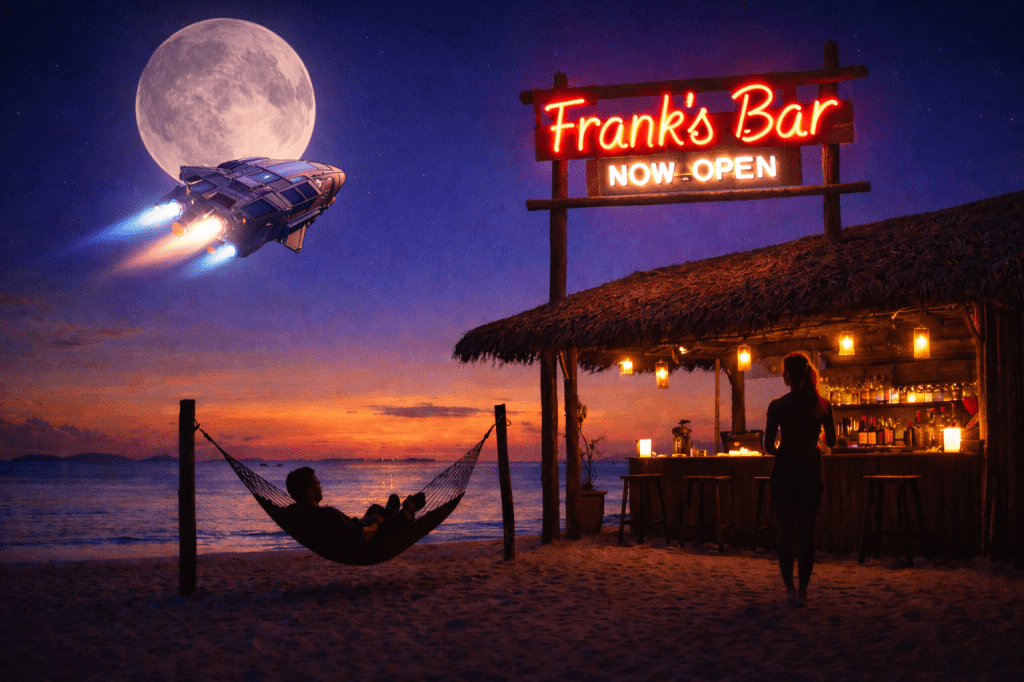
The President picks up the postcard. On the back is a small drawing of a glass of whisky. He turns it over and sees a picture-perfect photograph of a beach bar on golden sands, at dusk with the silver moon hanging high in the sky.
He can make out the silhouette of a man resting in a hammock. A woman with auburn hair stands next to him.
High above a neon sign welcomes customers. Frank’s Bar. Now open.
Copyright 2026 Steve Gillies. All rights reserved.
 Steve Gillies
Leave a comment