This is the third part of The Unwalked Path, a fictional tale focused on Sir Alexander Fleming, the discoverer of penicillin. Part 2 can be found here. It’s a ‘what might have happened in a world of human error tale’.
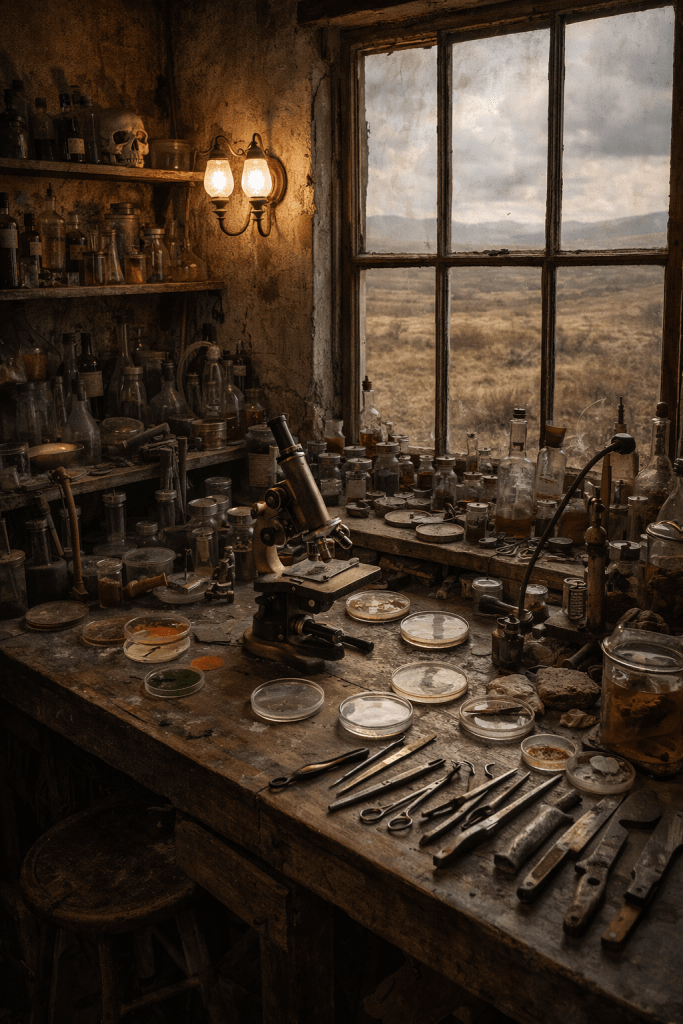
Alexander Fleming, Saturday, 9 June 1923, Lochfield Farm. Journal entry #2.
I find myself somewhat restricted in terms of equipment and precision. This is no complaint—merely a statement of circumstance—and history has demonstrated often enough that improvisation may yield the most interesting results.
I have remarked already upon the restorative qualities of the farm, though it has not been without its challenges. To begin with, there is no electricity—a circumstance that Sarah has met with varying degrees of resignation and protest. In my enthusiasm, I neglected to mention this when we were planning the journey. I also failed to note the absence of heating, the irregularity of provisions, and the fact that the nearest town lies some six miles distant.
I have adapted tolerably well, though I suspect this is largely because I had little alternative. Sarah, by contrast, has found the conditions more trying. Given her upbringing in Ireland and her experiences nursing in the trenches at Flanders, one might reasonably expect a certain stoicism. Yet London has softened her. She has grown accustomed to the comforts of modern life—a forgivable failing, I think.
My greatest practical difficulty has been the simple matter of establishing a reliable Bunsen flame. At St Mary’s, gas is conveniently piped to every bench; a turn of the tap produces an obedient, steady flame. Here, matters are rather different.
I have procured bottled propane, of course, though acquiring it—and transporting it from Edinburgh—proved an irksome business, both in effort and expense. Mrs Kyle regarded me as quite mad when I attempted to explain its necessity. I suspect she believes my work to involve some species of alchemy or sorcery. I have not yet disabused her of this notion, and the matter of the beef broth appears only to have confirmed her suspicions.
In the draughty workshop, maintaining a constant, well-aerated flame is often a matter more of prayer than of careful adjustment.
Nevertheless, I have contrived a serviceable arrangement. The conditions may be primitive, but science has endured worse. If Archimedes could make his discoveries while bathing in public, I can surely manage with a few inconveniences in the Scottish countryside.
It is Saturday now. Time behaves differently here—slower in some respects, yet the days seem to vanish before I have accomplished even half of what I intended.
I rose early and wrote to Almroth. I suspect he is mildly irritated by my temporary escape, though I also believe he finds some quiet amusement in my rural exile. The man has always enjoyed a good scientific anecdote, and I have no shortage of those at present.
We clash often, yet remain—after our own peculiar fashion—friends, and steadfast supporters of one another’s work. I hold his intellect in the highest regard: his precision, his method, his tireless curiosity. And yet his views on women try my patience sorely. He considers them biologically unsuited to scientific work, too governed by emotion for rigorous thought, and—inevitably—unfit for the franchise or positions of authority.
He is similarly dismissive of anyone he judges intellectually inferior. I have argued with him on these matters, though my objections seem to strike stone. It seems to me that he would be a better man were he able to relinquish such ideas and accept a broader, more generous view of human potential.
I hope—sincerely—that time may yet temper these convictions. A scientist ought to look forward, to welcome progress; yet he clings to certain outdated beliefs like an old man guarding his last shilling. Last Christmas I presented him with a volume of Burns, in the hope that the poet’s generosity of spirit might exert some influence. I regret to say I have observed no improvement. If anything, his opinions have hardened with age.
Still, he remains a brilliant colleague. And despite our many differences, I find myself wishing that one day he might come to see the world as I do—not as something to be neatly sorted and preserved by birth and blood, but as a place of possibility.
For now, however, I shall content myself with teasing him about my newly acquired knowledge of farm life. If nothing else, that may provoke a reluctant smile.
I awoke earlier than intended this morning, with the distinct sense that sleep had short-changed me. In need of remedy, I turned to my preferred restorative: Bunsen-burner coffee.
The preparation is, in its own way, as exacting—and as prone to disorder—as any laboratory procedure.
Grind: Measure two tablespoonfuls of Arabica beans and reduce them using my Arcade grinder, a sturdy metal-and-wood device well suited to travel.
Source: The beans must come from Thomson’s roastery, purchased from one of several cafés in Glasgow—ideally the Langside Café in Shawlands. Substitutes are unsatisfactory.
Heat: Pour one cup of water into a James A. Jobling & Co. beaker and heat to 190°F. Boiling is to be avoided, as it renders the brew bitter.
Pour: Transfer the heated water to a drinking vessel—or, on colder mornings, retain it in the beaker to warm the hands.
Enhance: Introduce a single drop of Lagavulin. Precision is essential. I employ a Rothe graduated pipette to prevent excess.
In time, the coffee achieved its purpose, and my thoughts came into focus.
Spread across the workbench were eighty Petri dishes from Wednesday’s experiments, awaiting inspection. I mounted samples on glass slides. At St Mary’s I would ordinarily rely upon an Eimer & Amend microscope—a fine instrument, though far too delicate for present conditions. Instead, I have with me a Leitz travelling microscope: a robust brass apparatus, German-made, housed in a purpose-built wooden case. Portable, reliable, and admirably suited to work in the field.
Lighting remains a difficulty. In the absence of electric illumination, I am obliged to rely upon sunlight entering through the large window of the workshop. Fortunately, the summer has been unusually bright—a rare kindness from the often-overcast west coast of Scotland.
With daylight on my side and my concentration restored, I turned to the first dish and peered into the microscopic world before me.
For those without training in bacteriology, a brief explanation may be useful. When undisturbed, bacteria appear under the microscope as minute, glistening colonies upon the surface of the agar. A healthy colony divides rapidly, producing visible clusters that expand steadily over time.
Having deliberately introduced each dish—infected may be the more accurate term—with different test substances, I was able to observe their effects. In some samples the bacterial structures were visibly altered: bent, distorted, or ruptured, their contents spilling into the surrounding medium. In others, growth had been arrested entirely, the colonies appearing inert and unchanged.
All were indications of antibacterial activity, though none differed in any meaningful way from results I had observed countless times before.
One experiment proved markedly different. Large regions of bacterial growth had vanished entirely, leaving a stark boundary between untreated colonies and a clear, lifeless zone. In places, the remaining bacteria appeared altered – clumped together, their structures thickened, as though attempting to resist whatever agent had been introduced. Whatever the cause, its effect was devastating.
I do not exaggerate when I say that what I observed this morning was extraordinary. I examined the plate again, and then again, uncertain whether fatigue—or an excess of whisky in my morning coffee—might be playing tricks upon me. I remained at the bench for some time, striving to steady myself and bring order to my thoughts.
At first glance, it appears that one of my experiments has produced something. My instinct is to call it wonderful; my reason insists upon interesting.
I understood at once that whatever this phenomenon proved to be, it would demand careful study. The experiment would need to be repeated—many times—under precisely controlled conditions, with each step documented and quantities measured with care. Only then could I hope to obtain results of any reliability.
It occurred to me that I had employed local materials, including cultures derived from my own preparations of beef broth. How readily could such results be reproduced? Would it even be possible to synthesise faithful replicas?
Careful planning would be essential. What resources would be required? Would I need assistance—a laboratory aide, perhaps? Could I secure sufficient quantities of the same organisms or active compounds? And how might I ensure consistent conditions in so improvised a workspace? Was it feasible to continue the work at Lochfield, or would a return to London be unavoidable?
My thoughts spiralled as each question gave rise to another.
I decided a good walk was exactly what I needed to clear my mind. Sarah was visiting Janet Morton at the neighbouring farm and wouldn’t be back until mid-afternoon, so I had time to ruminate on what I’d found and think deeply on what I had observed.
@ Copyright 2026 Steve Gillies. All rights reserved.
 Steve Gillies
Leave a comment