Fleming faces a harsh reality. Destiny’s path is settled. The consequences are clear. Part 5 can be found here. The last part of The Unwalked Path.
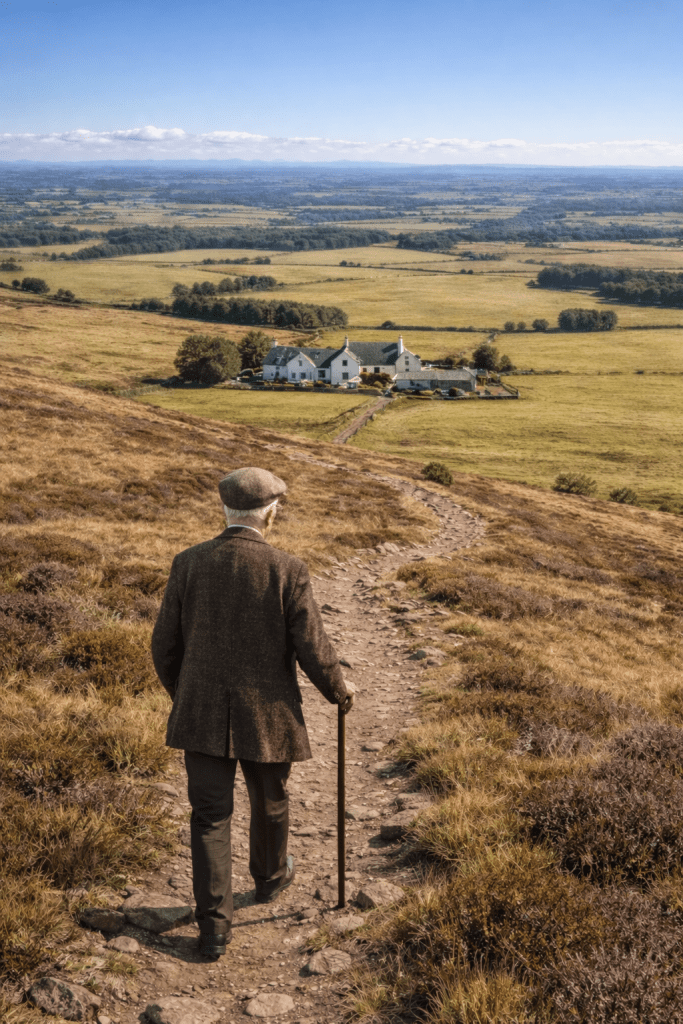
AI generated by author.
I turned back to the road, bracing myself for the final steep climb before the long track across the moors. I tried to remain calm, but the closer I came to home, the more my thoughts quickened with possibility. I was certain that what I had seen was more than a curiosity—perhaps monumentally important.
Yet the more I considered it, the more convinced I became that the remarkable inhibition of bacterial growth was not caused by any substance I had deliberately introduced. Something else had been at work—something introduced inadvertently.
It seemed that serendipity had intervened once more, though this time with effects far more potent, and with implications far greater, than my earlier work with lysozyme. I needed to know precisely what had produced such an outcome.
As I walked on, a woman approached from the opposite direction. There was something faintly familiar about her.
“Hello—you must be Dr Fleming,” she said.
I sighed inwardly. Another interruption. But in these parts, few pass without stopping for a blether. It is simply the way of things.
“Hello,” I replied, searching my memory. “You have the advantage of me. Your face is familiar, but forgive me—I can’t quite place you.”
“Oh, that’s all right. I don’t believe we’ve met before. I’m Mrs Anderson. My sister is Margaret.”
“Margaret?” For a moment the name failed to register. “Oh—you mean Mrs Kyle.”
“Aye. My sister. She lives with us at Lower Crofthead.”
“I didn’t know that,” I said. “She’s a gem, though she keeps herself to herself. Doesn’t speak much about her family.”
Mrs Anderson smiled. “That’s oor Maggie right enough. I had to do everything short of tying her doon to stop her from working today. She’s a grafter, that one.”
“On that we can agree,” I said. “It’s been good to speak with you, Mrs Anderson, but I really must be on my way. There’s a great deal of work waiting for me.”
I hesitated, then added, “Did you say you had to stop her from working today?”
“She had a bit of an accident this morning,” Mrs Anderson replied. “Badly twisted her ankle.”
“I hope she’s all right,” I said.
“She’ll be fine in a day or two. Just needs some rest. But don’t you worry, I’ve been doing her duties. I’ve tidied up, washed the windows, swept the floor, cleaned all those dishes you had lying about and put everything away.”
It took a while for me to process what she had said. I hesitated, hoping I had misheard “You cleaned everything up?”
“Yes.”
“And you washed all the dishes? The glass ones? The ones sitting on my lab bench?”
“Yes. And put everything away. It’s all sorted for you.” said Mrs Anderson as she turned, cheerily waved and walked away clearly pleased with her morning’s work.
For a moment, I could only stare in stunned silence. My heart pounded in my chest; my voice caught in my throat. After an eternity I managed to call out “Thanks, thanks for your help. Will Mrs. Kyle be back tomorrow?”
“No, Dr. Fleming, it’s the Sabbath tomorrow. I’m sure she’ll be fine on Monday,” she called over her shoulder.
A sudden wave of exhaustion washed over me. I slumped down on the drystane dyke, my body heavy with the weight of the day and my spirit devastated by the news. I was all but consumed.
Mechanically, I took a packet of Gold Flake from my jacket pocket and, fingers trembling, lit a cigarette. The familiar burn in my lungs was a temporary solace, the calming effect of the cigarette smoke fleeting. I sat frozen in thought and movement until the cigarette burned slowly between my fingers.
Looking up, the view before me was glorious – the rolling hills of Ayrshire, a perfect backdrop to the desolate moorland stretching away into the distance. A splash of wildflowers swayed in the gentle breeze surrounded by a perimeter of rowan trees, their white flowers glistening in the sun. Above, a skylark ascended in a near vertical climb. Its song – a cascade of bright, liquid notes – spilled into the air, a relentless melody of territorial claim and courtship. A song of defiance, persistence, and hope.
In contrast, a buzzard soared high, effortlessly riding the warm currents, its sharp eyes scanning the ground below. It was patient, calculating – its world dictated by what fate might provide before nightfall. A vole, a mouse or maybe a rabbit – life or death hanging in the balance. Forces beyond its control would ultimately decide its fate, but in the meantime, all it could do was to keep a keen eye and wait for the next opportunity.
Journal ends.
*****
Present day.
I’m sitting at the kitchen table, yawning between mouthfuls of breakfast, when Elaine walks in.
“Were you up late?” she asks.
“Half the night,” I say. “I was reading Fleming’s journal. I moved into the spare room so I wouldn’t wake you. Pour your coffee and I’ll tell you about it. And I’ll tell you something about your family you don’t know.”
Elaine raises an eyebrow, intrigued, and sits down. “Go on then.”
I recount the journal from start to finish: the makeshift laboratory, the walk to the Sheep’s Heid, Kinny Donal, and the strange woman he meets on his way back to Lochfield.
“So,” I say at last, leaning forward, “it looks as though Fleming may have stumbled onto something remarkable in 1923—five years before he officially discovered penicillin. And we’ll never know what it was because… well, because his cleaner twisted her ankle.”
Elaine frowns. “What do you mean?”
I hesitate, as though unsure how best to say it. “Well… and I don’t quite know how to tell you this… but it appears your great-grandmother was Fleming’s cleaner. For one day.”
Elaine looks at me. “So what?”
“Maggie Kyle—his regular cleaner—twisted her ankle, so her sister Annie stepped in. And when Fleming got back from his walk, she’d tidied up, cleaned everything… and washed all the Petri dishes.”
“And?” Elaine said, still unsure why this mattered.
“Think about it. Penicillin was officially discovered five years later, in 1928. It was—and still is—a miracle drug. It’s saved millions and millions of lives. But it wasn’t available in quantity until 1943, when it was deployed to Allied forces during the Second World War. Think how many more might have lived if it had been discovered in 1923 and available at the start of the war.”
Elaine gasped, her eyes widening. “Oh no. That’s… horrific, bizarre, and funny all at the same time. Are you saying my great-grandmother was responsible?”
“No. Not responsible,” I said. “Just an unwitting player in a chain of random events. On another day, another outcome.”
“Poor auld Annie,” Elaine said softly. “She’d be mortified if she knew what she’d caused.”
She fell quiet, as if turning the idea over. Could the course of human history really be altered by something so small, so random, so seemingly insignificant—in such an unremarkable place?
*****
WW2 Field Hospital, France
Private Jack Milroy lies on a blood-soaked stretcher in the dim haze of a French field hospital, the air is thick with the sting of iodine, sweat, and something darker—fear. His leg, wrapped in a hurried bandage, throbs with pain, each pulse a reminder of the shrapnel that has torn through him. Despite the nurses’ efforts, mud and grit cling stubbornly to his skin.
For days he drifts in and out of fevered sleep, suspended between pain and delirium. The nights are the worst. Groans echo through the gloom, broken only by the scurry of boots as medics and nurses hurry from cot to cot.
The doctor, pale and drawn, peels back the dressing. Jack can feel the stickiness of the wound beneath—hot, swollen, festering—as pus seeps from angry flesh. The stench of infection lingers in the air.
“Nous allons essayer davantage de poudre de sulfa,” the doctor murmured, his voice flat with resignation. There is no miracle drug here—only time, and the faint hope that his body might endure. Jack doesn’t understand French, but he understood enough.
Night arrives.
His breathing grows shallow and uneven. The infection has taken hold, advancing faster than anything can stop it. He turns his head slightly, eyes clouded with tears.
He thinks of his mother. Of his sister. Of the narrow lanes and quiet fields of the Vale. He feels again the moorland wind on his boyhood face, wild and free above the Loudoun Valley. He reaches out, searching for his wife’s hand.
At midnight, it was will be his birthday—26 January 1940. The last thing he feels is the nurse’s hand closing gently around his own.
@ Copyright 2026 Steve Gillies. All rights reserved.
 Steve Gillies
Leave a reply to The Unwalked Path: Part 5 – Steve Gillies Cancel reply